




Imagine ending another quarter hitting every metric. Your team executed flawlessly. Your clients are thrilled. Your board is satisfied.
On paper, the system is thriving. On the calendar, you are indispensable.
And yet, as you sit in your car in the quiet of your driveway after a twelve-hour day, you realize something unsettling: you didn’t actually feel any of it.
The wins don’t trigger joy. The setbacks don’t trigger urgency. You aren’t panicking, breaking down, or crying out for help. In fact, you will wake up at 5:00 AM tomorrow and do it all over again with flawless execution.
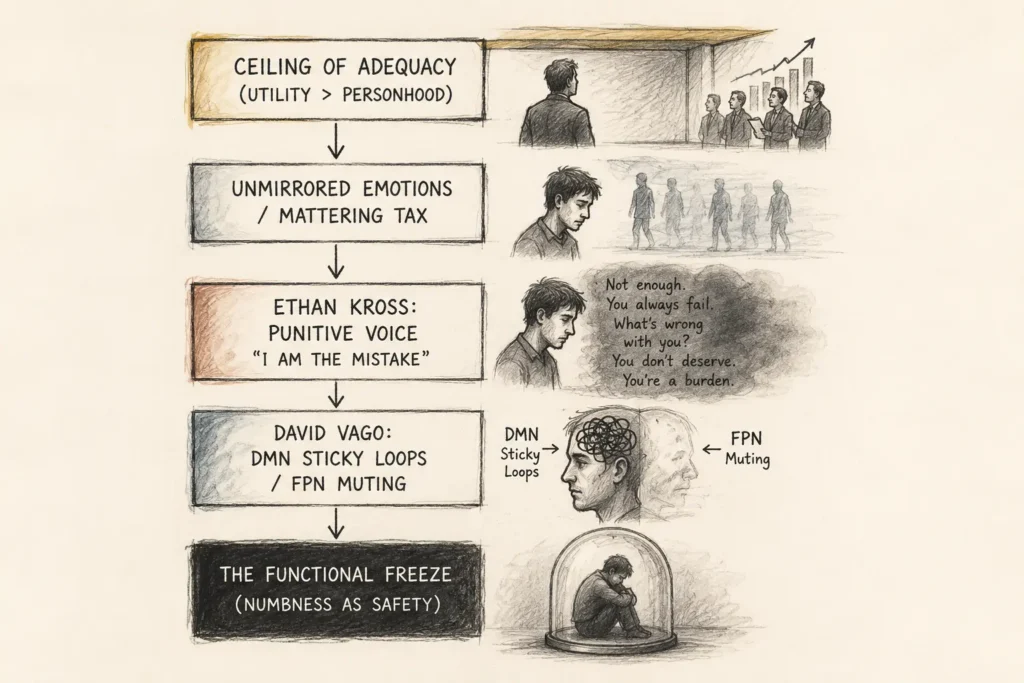
When I introduced The Ceiling of Adequacy, I described the structural trap where external success removes the evolutionary pressure for internal transformation. Settling for being useful to a system rather than essential to yourself extracts a hidden levy on your identity—what I call The Mattering Tax.
But what happens when you pay the Mattering Tax for years without relief? What happens to your mind and biology when you remain trapped beneath that comfortable ceiling?
You don’t break down. You freeze.
The Disguised Sanctuary
In clinical psychology, we often discuss freeze responses in the context of trauma—the body going limp when escape is impossible. But for high achievers, corporate executives, and dedicated leaders, the freeze response rarely looks like collapse.
It wears a far more dangerous mask: Grit. Professionalism. Having it together.
I call this state the Functional Freeze.
Definition: The Functional Freeze is an active, protective adaptation in which an individual sustains high operational output while internally disconnecting from their emotional life. It emerges when an environment treats your feelings as liabilities and your utility as your sole currency.
In a functional freeze, you don’t stop producing. You simply disappear from your own experience. You become an operational asset—highly visible to the market as a high-performing gear, but entirely absent from your own inner life.
How the Inner Voice Hardens: Ethan Kross on Self-Punishment
To understand how high-achievers transition from healthy ambition into a functional freeze, we have to look at what happens to our internal monologue when emotional mattering erodes.
When I spoke with psychologist Ethan Kross, author of Chatter, he pointed out that when people lose their sense of mattering, the mind does not go quiet. Instead, the inner voice undergoes a sinister shift: it stops practicing self-correction and begins practicing self-punishment.
| Dimension | Self-Correction (Healthy) | Self-Punishment (Functional Freeze) |
| Primary Question | “What went wrong?” | “What is wrong with you?” |
| Focus | Action, execution, and strategy | Identity, core worth, and existence |
| Role of Emotion | Data and information to adapt | A liability or weakness to be suppressed |
| System Outcome | Growth and course-correction | Structural numbness and identity fracture |
Underneath the Ceiling of Adequacy, the world praises you for what you produce while ignoring who you are. Your predictive brain registers this unmirrored state as a threat. To protect you from the pain of being unseen, your inner voice hardens.
As Ethan Kross told me:
“When the inner voice turns punitive, it stops saying, ‘You made a mistake,’ and starts saying, ‘You are the mistake.’ That is when identity fractures.”
Numbness, then, becomes a sanctuary. If feelings are liabilities that threaten your utility, the mind turns down the volume on all emotion to preserve operational control.
The Neuroscience of the Muffled Mind: David Vago on Threat Loops
This isn’t a failure of willpower or character. It is a biological adaptation.
Neuroscientist David Vago explains that emotional numbness occurs when specific neural networks shift out of balance under chronic emotional stress:
- The Default Mode Network (DMN): Responsible for self-referential thought and narrative, the DMN becomes “sticky.” It locks onto internal loops of threat, self-surveillance, and inadequacy.
- The Frontoparietal Network (FPN): Responsible for meta-awareness—our ability to observe an emotional storm without becoming it—the FPN gets overridden.
When you spend years paying the Mattering Tax, your brain’s prediction engine concludes that emotional vulnerability is unsafe. To prevent cognitive overwhelm, the nervous system dials down your emotional sensitivity. Sadness is muted, but so is joy. Longing is silenced, but so is gratitude.
You are left in a state of high-functioning numbness—a place where you are useful to everyone else, but completely optional to yourself.
The Anatomy of Disconnection: Useful vs. Frozen vs. Mattering
To see how the Functional Freeze connects to the broader architecture of human significance, consider where you currently operate across these three states:
| Structural Dimension | The Ceiling of Adequacy | The Functional Freeze | The Mattering Effect |
| External State | High output, praised utility | Flawless execution, high mask | Intentional action, aligned agency |
| Internal Experience | Disconnected from purpose | Emotionally flat, numb, quiet | Deep self-worth, grounded presence |
| Inner Voice | Transactional & demanding | Punitive (“You are the mistake”) | Self-correcting & compassionate |
| Relation to Worth | Conditional on metrics | Conditional on survival | Intrinsic (“I matter because I exist”) |
Thawing the Freeze: Moving from Resource to Source
If the Ceiling of Adequacy is the structural trap and the Functional Freeze is the internal state, how do we thaw?
You cannot force feeling back through sheer willpower. You cannot optimize your way out of a state that was created by over-optimization. Thawing requires changing your fundamental relationship with your worth through three practices established in The Mattering Effect:
1. Adopt a Sharing Mindset
Move away from managing a curated, high-performing exterior. Expressing inconvenient truths—fatigue, uncertainty, boundaries—interrupts the pattern of being valued purely as a functional utility.
2. Practice Non-Correction
Allow a “no” to remain a “no.” Allow frustration or sadness to exist without immediately fixing, softening, or apologizing for it. Non-correction retrains your nervous system to learn that emotional presence is not an operational failure.
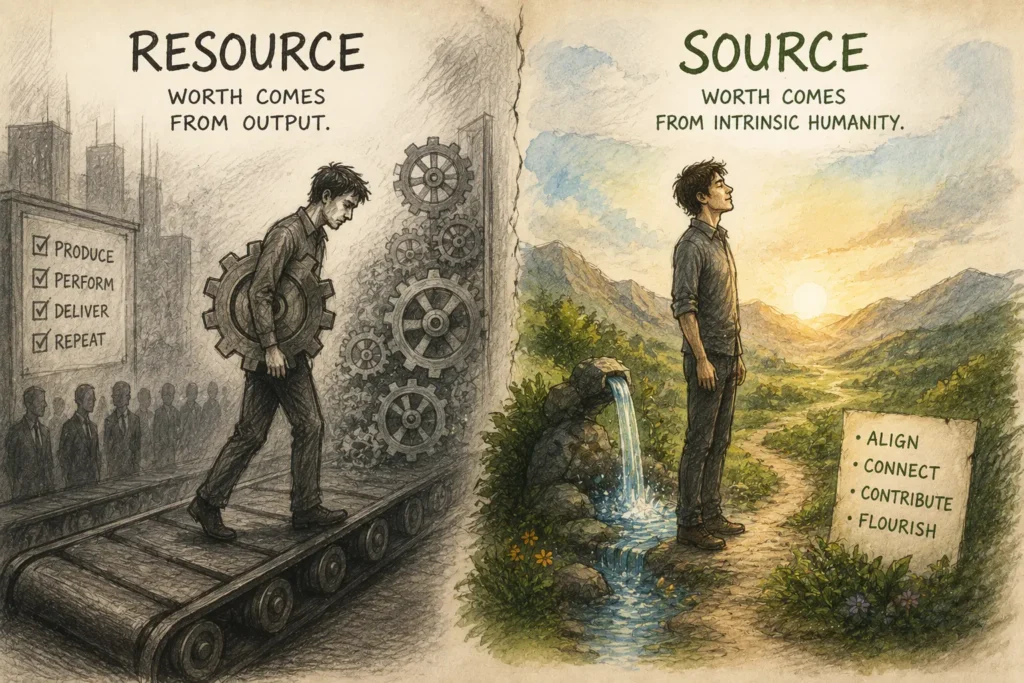
3. Shift from Resource to Source
- Being a Resource (Utility): Functioning as a predictable tool for a system where your acceptance is bought with continuous output.
- Being a Source (Essentiality): Grounding your worth in your intrinsic humanity—stepping out of the freeze and back into vital flow.
About the Author
John R. Miles is a former Fortune 50 C-level executive, combat veteran of the United States Navy, and the host of the Passion Struck podcast. As an author and keynote speaker, his work integrates behavioral science, human performance, and psychology to help individuals break automatic patterns and achieve lasting personal transformation. For more insights on behavioral adaptation and intentional living, subscribe to his weekly newsletter, The Ignited Life, on Substack.
Frequently Asked Questions
How does the Functional Freeze relate to the Ceiling of Adequacy?
The Ceiling of Adequacy is the external, structural trap where societal approval and high metrics stall your personal growth. The Functional Freeze is the internal, biological state that results from living beneath that ceiling—where your brain turns down emotional intensity to protect you from the exhaustion of being valued only for your output.
Is a Functional Freeze the same as burnout?
No. Burnout typically manifests as visible exhaustion, cynicism, and declining performance. In a Functional Freeze, your external performance remains exceptionally high. You continue to meet deadlines and lead teams, but you do so while completely detached from your internal emotional experience.
What is the Mattering Tax?
The Mattering Tax is the exhausting psychological fee you pay when you spend your vital energy continuously proving your worth to justify your seat at the table. When left unchecked, paying this tax leads directly to a Functional Freeze.
How does the default mode network keep someone locked in a freeze?
Neuroscientist David Vago notes that under chronic emotional stress, the default mode network becomes sticky, generating repetitive, self-referential loops focused on internal threats and inadequacy. This overrides the frontoparietal network’s ability to observe emotions non-judgmentally, causing the brain to mute emotional intensity as a sanctuary.
What does it mean to shift from being a resource to a source?
Being a resource means operating as a predictable tool for an organization, family, or system where your value is conditional on output. Being a source means recognizing that your intrinsic worth originates within your humanity—allowing you to act with genuine agency rather than transactional utility.
How can a leader help an employee who is in a functional freeze?
Leaders can help by shifting from praising execution to recognizing personhood. This involves creating psychological safety where non-work experiences are validated, non-correction is respected, and individuals are seen as irreplaceable sources of value rather than interchangeable resources.