



Have you ever had an idea at work but decided not to share it? Perhaps you noticed a problem but stayed quiet because you were unsure how your manager would react. Or maybe you had a different perspective but felt that nobody would take it seriously.
These moments reveal something important about workplace relationships: people do not always speak up simply because they have something valuable to say. They also need to feel that their voice matters.
Mattering at work and psychological safety are intersect. Psychological safety helps people feel comfortable expressing ideas, asking questions, admitting mistakes, and raising concerns without fearing humiliation or punishment. Mattering adds another important dimension: knowing that your presence, perspective, and contributions are valued.
When employees feel that they matter, speaking up can become less intimidating and more meaningful. They are not simply given permission to participate. They feel that their participation counts.
What Is the Connection Between Mattering and Psychological Safety?
Mattering is the experience of feeling seen, valued, and needed. It means knowing that your presence and contributions make a meaningful difference to other people.
Psychological safety, a concept widely associated with Harvard Business School professor Amy Edmondson’s research, refers to a shared belief that a team is safe for interpersonal risk-taking. In psychologically safe environments, people can ask questions, admit mistakes, disagree, and share concerns without expecting humiliation or punishment.
The two concepts are closely connected, but they are not identical.
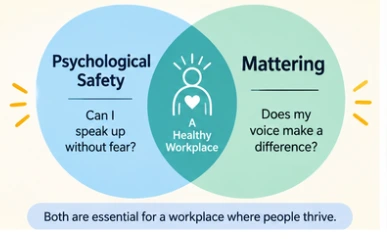
Psychological safety helps answer: Can I speak up without fear?
Mattering helps answer: Does my voice make a difference?
An employee might feel comfortable sharing an idea but still believe that nobody genuinely values their perspective. Similarly, someone might feel appreciated for their work but hesitate to challenge a decision because disagreement feels risky.
A healthy workplace needs both. People should feel safe enough to speak and valued enough to know that their contributions matter.
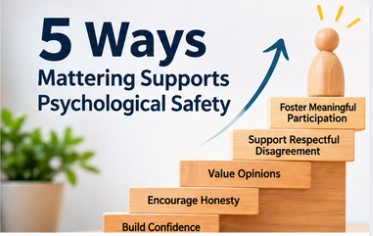
5 Ways Mattering Supports Psychological Safety at Work
1. Feeling Valued Gives Employees Confidence to Speak Up
Employees are more likely to share ideas when they believe their perspectives are respected.
When managers listen carefully, acknowledge different viewpoints, and respond thoughtfully to questions, they communicate that employees have something valuable to contribute.
By contrast, repeatedly dismissing suggestions or interrupting employees can make people question whether speaking up is worthwhile.
What leaders can do: Invite different perspectives during meetings and acknowledge contributions even when an idea is not adopted.
2. Trust Makes It Easier to Admit Mistakes
Mistakes are part of learning and problem-solving. However, employees may hide errors when they expect blame, embarrassment, or negative consequences.
Psychological safety encourages people to acknowledge mistakes and discuss what can be learned from them.
Mattering strengthens this experience by helping employees understand that their worth is not defined by a single mistake or performance outcome.
When people feel respected beyond their productivity, they may be more willing to ask for help and acknowledge uncertainty.
What leaders can do: Respond to mistakes with curiosity and accountability rather than automatic blame. Focus on understanding what happened and how to improve.
3. Employees Feel Their Opinions Have Value
Being allowed to speak is not the same as being heard.
Organizations sometimes encourage employee feedback but fail to demonstrate that it influences anything. Over time, people may stop sharing ideas because they do not expect a meaningful response.
Mattering reminds leaders that employees need to know their perspectives count, even when their suggestions cannot always be implemented.
What leaders can do: Close the feedback loop. Explain which suggestions were adopted, which were not, and why.
4. Respectful Disagreement Strengthens Team Relationships
Healthy teams do not need everyone to agree. Different perspectives can help organizations identify problems, question assumptions, and make better-informed decisions.
However, employees need to believe that disagreement will not damage their relationships or professional standing.
When leaders demonstrate respect during difficult conversations, they show that differences of opinion do not reduce someone’s value.
What leaders can do: Encourage constructive disagreement and separate criticism of an idea from judgment of the person sharing it.
5. Feeling Significant Encourages Meaningful Participation
People want to know that their presence makes a difference.
When employees understand how their ideas and contributions influence team outcomes, participation becomes more meaningful. They are not simply attending meetings or completing assigned tasks. They are contributing to something that matters.
This is an important distinction between participation and mattering.
What leaders can do: Connect employee contributions to real decisions, improvements, and outcomes.
The Mattering Gap: When People Have a Voice but Do Not Feel Heard
The Mattering Effect describes the distance between what people contribute and how much they feel their significance is recognized as the Mattering Gap.
This gap can appear in workplaces that technically encourage open communication.
Employees may be invited to meetings, asked to share feedback, and encouraged to contribute ideas. Yet their suggestions may repeatedly go unanswered, their concerns may be overlooked, or their perspectives may carry little influence.
Over time, employees can begin to question whether their voices genuinely matter.
This creates an important distinction: having a voice does not automatically mean feeling heard.
Psychological safety creates the conditions for people to speak. Mattering helps ensure that their participation is treated as meaningful.
Organizations should therefore look beyond whether employees speak up and consider whether they believe their contributions are taken seriously.
How Leaders Can Build Mattering and Psychological Safety Together
Creating a workplace where people feel safe and valued requires consistent leadership behavior.
The M.A.T.T.E.R. framework offers six dimensions that can help leaders examine these experiences.
- Meaning: Help employees understand how their ideas and contributions influence meaningful outcomes.
- Autonomy: Give people appropriate ownership and encourage independent thinking.
- Trust: Respond to questions, concerns, and mistakes with fairness and consistency.
- Time: Make space for conversations instead of rushing through every interaction.
- Energy: Create sustainable working conditions where employees have the capacity to participate.
- Reciprocity: Ensure employees receive respect, attention, and support in return for their contributions.
Together, these dimensions encourage leaders to create environments where people can participate openly and experience genuine significance.
Explore the M.A.T.T.E.R. Framework to understand these six dimensions in greater depth.
5 Practical Ways to Encourage Employees to Speak Up
Leaders can strengthen psychological safety and mattering through everyday actions:
- Ask open-ended questions. Invite employees to share what they think, what concerns them, and what could be improved.
- Listen without becoming defensive. Give people room to express concerns before explaining or defending a decision.
- Acknowledge different perspectives. Show that disagreement is welcome when it is respectful and constructive.
- Follow up on feedback. Communicate what action was taken and explain decisions that could not be changed.
- Recognize people beyond their output. Show interest in employees’ ideas, experiences, strengths, and development.
These actions help turn psychological safety from an organizational statement into an everyday experience.
Frequently Asked Questions
1. What is the relationship between mattering and psychological safety?
Mattering and psychological safety are connected because both influence how people experience their relationships at work. Psychological safety helps employees feel able to speak up without fear of humiliation or punishment. Mattering helps them feel that their voices, contributions, and presence are valued.
2. How does feeling valued encourage employees to speak up?
When employees believe their perspectives are respected, they may feel more confident sharing ideas, asking questions, and raising concerns. Feeling valued can reduce the sense that speaking up is pointless or unwelcome.
3. What is the difference between psychological safety and mattering?
Psychological safety is about feeling safe enough to take interpersonal risks, such as asking questions or admitting mistakes. Mattering is about feeling seen, valued, and significant to others. One concerns the safety of participation; the other concerns the significance of the person participating.
4. How can leaders create psychological safety in the workplace?
Leaders can encourage open communication, respond constructively to mistakes, welcome different opinions, avoid humiliating employees, and demonstrate that feedback is taken seriously. Consistent behavior is essential to building trust.
5. Can employees feel psychologically safe but still not feel that they matter?
Yes. Employees may feel comfortable expressing opinions but still believe their contributions have little influence or significance. Psychological safety does not automatically create a sense of mattering. Organizations need to demonstrate that employee voices are not only welcome but also valued.
Conclusion: People Need to Know Their Voices Matter
A workplace where people feel safe to speak up is important. But safety alone is not the whole story.
Employees also need to know that their ideas, perspectives, and contributions make a difference. They need to feel that they are valued as people, not simply permitted to participate.
The connection between mattering and psychological safety reminds leaders that meaningful communication requires more than an open-door policy. It requires trust, respect, attention, and a genuine willingness to recognize the significance of others.
When people feel safe enough to speak and valued enough to know their voices matter, workplaces can become stronger environments for learning, collaboration, and human connection.
Because being heard is important. Knowing that you matter is something deeper.