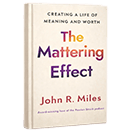





John R. Miles is the author of The Mattering Effect, a landmark work on human significance, releasing October 6, 2026, through Waterbrook/Penguin Random House. His research explores why so many people, despite achieving by every conventional measure, still find themselves asking whether any of it actually means something. This article examines one of the central tensions his work addresses: the widespread and deeply costly confusion between success and mattering. If you are a high achiever who has reached the summit and spent years climbing only to feel curiously empty at the top, the distinction explored here may reframe everything you thought you understood about worth, recognition and a life well lived.
The Myth That Achievement Equals Worth
Modern culture has spent decades constructing a story so persuasive that most people absorb it before they are old enough to question it. The story goes like this: if you work hard, earn the title, hit the number, win the award and accumulate the proof, you will feel valued. You will feel seen. You will, in short, matter. This promise is so embedded in professional culture, parenting philosophies and school systems that challenging it can feel almost heretical. Yet the evidence for its accuracy is remarkably thin.
High achievers, more than any other group, tend to build their entire identity on this equation. They learn early that performance earns approval, so they perform. They learn that credentials signal competence, so they accumulate credentials. The feedback loops are intoxicating at first: the grades, the promotions, the followers, the income. Every external metric that climbs seems to confirm the premise. The problem only becomes visible much later, when the metrics are excellent, but the felt sense of significance still has not arrived.
What these individuals are discovering, often painfully and in the middle of what should be their most triumphant seasons, is that success and mattering are not the same destination reached by the same road. They are different experiences entirely. Success is about outcomes. Mattering is about the recognition of your inherent worth as a person. You can accumulate one indefinitely while the other remains absent and no amount of the former can manufacture the latter.
This confusion is not a personal failing. It is, as John R. Miles argues throughout his work, a structural problem built into the way contemporary society assigns and withholds significance. To understand why, it helps to look at what systemic unmattering actually does to a person over time, even a person the world would describe as extremely successful.
What Research Actually Shows About Success and Mattering
Viktor Frankl, writing from the brutal laboratory of the Nazi concentration camps in Man’s Search for Meaning, observed that survival itself was insufficient to produce a life worth living. What kept people psychologically intact was not comfort, status, or achievement but a felt sense of meaning and connection to something beyond the self. Frankl argued that the primary human motivation is not pleasure or power but the pursuit of meaning and that when meaning is absent, no achievement adequately fills the void.
Decades later, the positive psychology movement began generating empirical data that pointed in the same direction. Ed Diener, widely regarded as one of the founding figures of well-being research, demonstrated through large-scale studies that subjective well-being correlates far more strongly with social relationships, a sense of purpose and felt significance than with income or status beyond a certain baseline. His research, replicated across cultures and income levels, consistently showed that people who feel they matter to others report dramatically higher life satisfaction than those who achieve without belonging.
More recent work in social neuroscience has added a biological layer to this picture. Matthew Lieberman, in his research on the social brain, has shown that the neural systems humans use to process the need for belonging are among the most ancient and powerful in the brain. When those systems are not being adequately fed by genuine connection and felt significance, no external achievement quiets them. The brain does not register a promotion as mattering. It registers being seen, valued and needed as mattering.
This body of evidence suggests that the pursuit of success as a proxy for mattering is not merely philosophically misguided. It is neurologically and psychologically futile. The human nervous system was not built to treat external recognition as a satisfying substitute for genuine significance.
The Hollow Achievement Pattern
There is a pattern that appears repeatedly among high performers who have achieved what they set out to achieve. They reach a milestone, receive the recognition and wait for the feeling they were promised. For a brief window, the feeling arrives. Then it recedes, often faster than they expected. What remains is an ambient pressure to produce the next milestone, because only by staying in motion does the emptiness stay quiet.
This pattern is not depression, though it can shade into it. It is more accurately described as a hunger that achievement does not feed. The person caught in it is often described by others as driven, successful and admirable. They describe themselves, in their more honest moments, as exhausted and unseen. They have built impressive structures on the outside. They have not yet built a felt sense of worth on the inside. And they are beginning to suspect, uncomfortably, that all their external buildings were aimed at filling an interior space that works by entirely different rules.
One of the cruelest features of this pattern is that it tends to isolate the people who experience it. Because they appear successful, they face little social permission to speak about the emptiness. Admitting that achievement has not delivered significance feels like ingratitude, or worse, like a confession that they have somehow failed to earn what they were after. So they accelerate. They add another goal, another credential, another milestone. The question of whether any of it constitutes mattering gets deferred indefinitely.
Why External Metrics Erode Internal Worth Over Time
There is a feedback mechanism at work in high-achievement cultures that most people do not notice until it has been running for years. Every time you seek external validation as proof of your worth, you subtly reinforce the belief that your worth is conditional. You train yourself, over thousands of repetitions, to experience your significance as something you must earn rather than something you already possess. The more successfully you do this, the more fragile your sense of self becomes, because it is entirely dependent on continued external confirmation.
Psychologists call this contingent self-worth and the research on it is sobering. Jennifer Crocker at the University of Michigan spent years studying people whose self-worth was heavily staked to external performance domains, including academic achievement, professional success and appearance. Her findings showed that people in this group experienced more anxiety, more depression, more interpersonal conflict and less genuine learning over time than those whose self-worth was based on more stable internal foundations. Success, paradoxically, became a source of chronic stress rather than satisfaction for those who needed it most urgently as a mirror for their worth.
The process of erosion is gradual. In early career stages, the equation seems to work. Performance earns praise, praise feels like recognition and recognition feels adjacent to mattering. But as the person climbs higher, the recognition becomes more institutional and less personal. The audience grows, but the intimacy shrinks. The applause gets louder, but the feeling of being truly seen, genuinely known and actually needed quietly disappears. By the time most high achievers recognize what has happened, they have organized their entire life around a system that was always structurally incapable of delivering what they were actually after.
How The Mattering Effect Reframes Achievement and Significance
The central argument of The Mattering Effect is not that achievement is worthless or that striving is misguided. John R. Miles is careful to distinguish between ambition in service of meaning and ambition as a substitute for meaning. The former can be deeply generative. The latter is a trap. What his framework offers is a way to disentangle the two, so that people who want to achieve can do so from a foundation of felt significance rather than in a desperate search for it.
The Mattering Effect, as Miles defines it, is what happens when a person consistently experiences being seen, valued and needed within their relationships, communities and work. It is not a feeling you manufacture alone. It is inherently relational. It arises when people invest in one another’s significance, when they practice what he calls reciprocal mattering: the deliberate act of making others feel seen and valued in ways that simultaneously deepen your own sense of connection and worth.
This reframe has a practical implication that many high achievers find both relieving and disorienting. It means that significance is not a reward you receive after reaching some threshold of performance. It is something you can cultivate right now, in the relationships and communities you already inhabit, by shifting attention from what you are accomplishing to how deeply you are connecting. Achievement can still be part of a flourishing life. But it has to be built on top of genuine mattering, not deployed as a substitute for it.
Miles also introduces the concept of the Great Erasure, his term for the cultural and systemic forces that quietly strip people of their felt significance, often without their awareness. Understanding the Great Erasure is essential context for anyone trying to make sense of why the high-achievement path so reliably leads to the hollow place. The systems around us are not neutral. They are actively organized to reduce mattering to metrics, which means resisting that reduction requires intentional, deliberate practice.
A Pattern Worth Naming: The Late-Career Reckoning
Across many fields, a recognizable pattern emerges in the years between forty-five and sixty among people who have achieved at high levels. Outwardly, everything appears intact: the career, the reputation, the financial stability. Inwardly, something has gone quiet that the person cannot quite name. They have stopped finding genuine energy in the work. They feel disconnected from the people around them despite being constantly surrounded by colleagues, clients and admirers. They have a persistent sense that the most important things somehow got deferred while they were busy succeeding.
This is not a midlife crisis in the caricatured sense. It is something more specific and more instructive. It is the moment when the gap between success and mattering becomes impossible to paper over with the next achievement. The person has run out of milestones big enough to postpone the reckoning. And the reckoning, when it arrives, is almost always about the same thing: a hunger to matter that decades of achievement never satisfied.
The good news, which Miles makes central to his work, is that this reckoning is not an ending. It is an opening. The capacity for genuine mattering does not diminish with age. It often deepens, as people become more willing to trade performance for presence and more skilled at the kind of reciprocal investment that creates lasting significance. The late-career moment, reframed, is not a failure of the achievement project. It is an invitation to build something more durable on top of it.
Frequently Asked Questions
What is the difference between success and mattering?
Success refers to the achievement of external goals: income, status, credentials, recognition and performance outcomes. Mattering refers to the felt sense that you are seen, valued and needed by others in ways that are personal and reciprocal. You can accumulate significant success while your sense of mattering remains low, because the two experiences are generated by different mechanisms. Success is produced by performance. Mattering is produced by genuine human connection and belonging.
Why do high achievers often feel empty despite their accomplishments?
Research in positive psychology and social neuroscience consistently shows that subjective well-being is more strongly correlated with social connection and felt significance than with income or status. High achievers who have organized their sense of worth around external performance build a psychologically fragile foundation. When the performance continues but the personal recognition becomes more institutional and less intimate, the felt sense of mattering quietly erodes even as the external metrics improve.
What does John R. Miles mean by the Great Erasure?
The Great Erasure is John R. Miles’s term for the cultural and systemic forces that strip people of their felt significance, often without their awareness. These forces reduce human worth to productivity, output and measurable performance, effectively communicating that people matter only insofar as they produce. This systemic unmattering is built into the structures of modern professional life, education and media and resisting it requires deliberate, ongoing practice in how you relate to yourself and others.
Can achieving things and mattering coexist?
Absolutely and this is a core distinction in The Mattering Effect. John R. Miles does not argue against ambition or achievement. He argues that achievement becomes sustainable and genuinely satisfying only when it is built on top of a foundation of real mattering. People who achieve from a place of felt significance tend to pursue goals that are more aligned with their values, experience less chronic stress and find genuine meaning in their work. The problem is not achieving things. The problem is pursuing achievement as a substitute for mattering rather than as an expression of it.
What is reciprocal mattering and how do you practice it?
Reciprocal mattering is the practice of deliberately investing in other people’s felt significance: seeing them, acknowledging their worth and demonstrating that they are genuinely needed and valued. Miles argues that this practice is mutually generative. When you help others feel that they matter, you simultaneously deepen your own sense of connection and significance. Practically, this looks like giving full attention in conversations, expressing specific appreciation and showing up with genuine interest in the people around you rather than treating them as an audience for your performance.
When does The Mattering Effect publish?
The Mattering Effect by John R. Miles publishes October 6, 2026, through Waterbrook/Penguin Random House. The book offers a comprehensive framework for understanding and cultivating genuine significance in your relationships, work and daily life.
Key Takeaways
- Success and mattering operate through fundamentally different mechanisms: success is produced by performance, while mattering is produced by genuine human connection and reciprocal recognition of worth.
- Research by Viktor Frankl, Ed Diener and Matthew Lieberman converges on the same finding: subjective well-being and life satisfaction depend far more on felt significance and belonging than on income, status, or achievement beyond a basic threshold.
- High achievers who build contingent self-worth on external performance become more psychologically fragile over time, because the system they rely on is structurally incapable of delivering genuine significance.
- The Mattering Effect, as defined by John R. Miles, arises through reciprocal investment: the deliberate practice of seeing, valuing and acknowledging others in ways that generate mutual significance and deepen connection.
- The late-career reckoning many high performers experience is not a failure of the achievement project. It is an invitation to build something more durable: a life grounded in real mattering rather than in its successful simulation.
Conclusion
The most persistent myth in high-performance culture is not that hard work pays off, it often does. The myth is that the payoff is significance. That if you build the resume, earn the title and prove yourself by every available metric, you will eventually arrive at a place where you feel genuinely valued, truly seen and meaningfully needed. Decades of psychological research and the quiet testimony of thousands of high achievers who have reached their destinations and found them strangely empty tell a different story.
Success and mattering are not the same journey. They do not lead to the same place. Mattering requires something that no credential can supply: the experience of genuine, reciprocal human connection grounded in the recognition of your worth as a person rather than as a performer. Building that experience is the work John R. Miles has dedicated himself to understanding and The Mattering Effect offers the most rigorous and humane framework currently available for doing it.
For a deeper examination of the forces working against your significance, read about systemic unmattering and how to recognize when it is happening to you. Browse more articles on significance, flourishing and intentional living on the Mattering Effect Blog.
The Mattering Effect by John R. Miles publishes October 6, 2026, through Waterbrook/Penguin Random House. Pre-order your copy today and begin building a life where success and significance finally align.