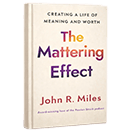





John R. Miles is a leadership researcher, podcast host and the author of The Mattering Effect (Waterbrook/Penguin Random House, October 6, 2026). At the center of his work sits a precise diagnostic tool: the M.A.T.T.E.R. framework, a six-signal model that explains why some people feel seen, valued and needed, while others feel invisible even in the middle of full lives.
Each letter stands for a distinct psychological signal: Meaning, Autonomy, Trust, Time, Energy and Reciprocity. When all six are present, you experience what Miles calls the Mattering Dividend, a measurable uplift in well-being, performance and resilience. When they erode, you enter what he calls systemic unmattering: a slow, cumulative loss of significance that most people cannot name but everyone can feel.
This article walks through each signal in depth, shows what their absence looks like in real life and explains why the framework matters for how you lead, relate and live.
If you are new to John’s work, start with what the Mattering Effect is before continuing here. The M.A.T.T.E.R. framework is the diagnostic layer that sits beneath that larger concept.
What the M.A.T.T.E.R. Framework Is and Why It Exists
Most conversations about belonging and purpose stay at the level of feeling. The M.A.T.T.E.R. framework goes deeper.
Miles designed it as a structural audit: a way to ask not just “do I feel like I matter?” but “which specific signal has gone quiet and why?” That precision matters because vague distress rarely produces useful action. If you cannot name what is missing, you cannot repair it.
The six signals are not a checklist to complete once. They are ongoing conditions that require continuous renewal, from institutions, from relationships and from your own choices.
Research in occupational psychology, developmental science and organizational behavior consistently finds that humans need more than baseline safety and compensation to flourish. They need to feel that their existence makes a difference. The M.A.T.T.E.R. framework operationalizes that need into six discrete, observable and addressable signals.
Understanding the framework also reframes how you interpret others. When a colleague withdraws, when a teenager goes silent, when a long-term employee stops contributing ideas, the question is no longer “what is wrong with them?” It becomes “which signal are they not receiving?” That shift, from judgment to diagnosis, is one of the framework’s most practical gifts.
The Six Signals of the M.A.T.T.E.R. Framework
M, Meaning
Meaning is the signal that tells you your presence serves a purpose larger than your immediate tasks. It is not the same as happiness, satisfaction, or even passion. Meaning is the experience of contributing to something that will outlast the moment.
Viktor Frankl identified this as the foundational human drive; decades of subsequent research, including longitudinal work by researchers at Stanford’s Center on Longevity, confirms that meaning predicts well-being and longevity with more reliability than comfort or pleasure.
In practical terms, meaning shows up as the sense that your work, your relationships, or your choices have weight. It is eroded when people are given tasks without context, roles without purpose statements, or relationships where they feel interchangeable.
When meaning is absent, effort stops feeling worth the cost, not because people are lazy, but because the human mind needs to understand why effort matters before it can sustain it.
Restoring the meaning signal is often simpler than it sounds. It requires someone, a manager, a partner, a community, to articulate the “so that” behind the ask. Not “please do this” but “please do this so that these people benefit in this way.”
A, Autonomy
Autonomy is not simply freedom. It is the signal that you have genuine agency over decisions that affect your life. The distinction is important: you can have many choices and still feel no autonomy if none of those choices touch anything that matters to you.
Autonomy is violated not only by overt control but by the subtler experience of having your judgment perpetually second-guessed or your expertise ignored.
Edward Deci and Richard Ryan’s self-determination theory, developed over four decades of research, places autonomy as one of three universal psychological needs, alongside competence and relatedness. When it is present, intrinsic motivation rises.
When it is absent, even generous incentives produce only compliance, not engagement. In organizations, this explains why high-pay, low-autonomy roles produce burnout at rates that high-pay, high-autonomy roles do not.
For individuals, the autonomy signal asks a clarifying question: in the decisions that shape your actual life, how you work, how you spend your time, how you define success, are you the author or the subject? Many people discover, when they sit with that question, that they have been living according to a script they never chose.
T, Trust
Trust is the signal that says you are safe to be seen. It is the condition under which people reveal their actual thinking, take meaningful risks and invest in relationships and institutions beyond the transactional minimum.
Without trust, mattering is always provisional; you matter as long as you perform, as long as you conform, as long as you stay useful. The moment that the condition feels uncertain, the signal collapses.
Trust operates at multiple levels simultaneously. There is interpersonal trust, the belief that specific people will honor what they say and protect what you share. There is structural trust, the belief that the systems you operate within are fair and consistent.
And there is self-trust, the conviction that your own perceptions and judgment can be relied upon. Psychological safety research, led by Amy Edmondson at Harvard Business School, shows that team performance is predicted less by individual talent than by the degree to which members trust it is safe to speak honestly.
Rebuilding the trust signal requires consistent, small-scale honesty over time. It cannot be declared; it can only be demonstrated. This makes trust the slowest of the six signals to restore once it has been damaged and the most consequential to protect.
T, Time
The second T in the framework stands for Time, specifically, the signal that your time, presence and attention are treated as valuable by others and by yourself.
When someone gives you their genuine, undistracted attention, it communicates mattering at a register that words often cannot reach. Conversely, being perpetually interrupted, rescheduled, or made to wait sends a signal that your presence is low-priority, regardless of what anyone says aloud.
Time as a signal of mattering is culturally underexamined. In 2026, attention is fragmented at an almost structural level.
Research published in the Journal of Experimental Psychology found that even the presence of a silenced phone on a table reduces cognitive performance and the subjective sense of connection during conversation. The time signal is not just about hours; it is about the quality of presence those hours contain.
For leaders and parents alike, restoring the time signal often requires nothing more expensive than undivided attention during conversations that the other person has signaled are important. The scarcity of that experience in contemporary life means its value is higher than it has ever been.
E, Energy
Energy as a mattering signal refers to the vitality, enthusiasm and engagement that others bring into interactions with you and that you bring into interactions with others. It is the felt sense of whether someone is genuinely present or merely going through motions.
When a mentor leans forward and asks a question that only makes sense if they have been listening deeply, the energy signal fires. When a manager reads a performance review in a monotone without looking up, it extinguishes.
Energy is also the signal most susceptible to chronic depletion. Research on emotional labor, the work of managing one’s expressed emotions to meet social expectations, shows that sustained suppression of genuine response creates a specific kind of exhaustion that sleep does not fully repair.
People who cannot bring authentic energy to their relationships because they are running a permanent performance find, over time, that their capacity for genuine connection atrophies.
This is one reason Miles argues that human flourishing cannot be treated as purely individual. The energy signal requires two people. You cannot supply it for yourself. The question it asks is not just “am I energized?” but “do the people around me bring energy to our shared space and do I bring energy to theirs?”
R, Reciprocity
Reciprocity is the signal that the giving in your relationships flows in both directions. It does not mean scorekeeping or transactional exchange; it means the felt sense that your contributions are acknowledged, that your needs are noticed and that the people and institutions you invest in invest back.
Mattering in a one-directional relationship is unsustainable; you eventually run out of the internal resource that enables you to keep showing up.
The reciprocity signal is frequently the one that breaks quietly over the years before anyone names the pattern. A relationship that begins with mutual investment gradually becomes asymmetric; one person carries the emotional weight, tracks the details, initiates the repair.
The other person may not be malicious; they may simply have stopped noticing. But the cumulative effect is a signal failure as significant as any of the others.
Restoring reciprocity requires naming the asymmetry without accusation, then establishing new behaviors, not grand gestures, but regular, small acts that confirm the other person’s contributions are seen. In organizational life, this is the difference between a manager who acknowledges effort publicly and one who only appears when something goes wrong.
When Multiple Signals Go Quiet: The Experience of Systemic Unmattering
The M.A.T.T.E.R. framework is most useful when you treat the signals as interdependent rather than isolated. The loss of one signal is painful but manageable. The loss of several simultaneously produces what Miles terms systemic unmattering, a condition in which the cumulative erosion of significance becomes self-reinforcing.
When meaning disappears from work, autonomy is restricted and the time signal collapses into constant interruption; the experience is not the sum of three separate losses. It is qualitatively different: a pervasive sense that you are present in your own life but not a protagonist in it.
Systemic unmattering is particularly insidious because it produces symptoms that are frequently misdiagnosed. Depression, disengagement, chronic fatigue and what the organizational literature calls “quiet quitting” are often not primary conditions; they are downstream effects of prolonged signal failure. Treating the symptoms without diagnosing the underlying signal failures is like addressing smoke without investigating the fire.
Research by Gallup’s State of the Global Workplace report (2025) found that 62 percent of employees are disengaged from their work, a figure that has remained stubbornly high for over a decade.
Miles’s framework offers a structural explanation: disengagement is not primarily a motivational failure. It is a mattering failure, produced by environments that systematically withhold the signals humans need to feel that their presence counts.
Observed Patterns: What Signal Failure Looks Like in Practice
Consider the experience described repeatedly by people who feel invisible at work: competent, committed professionals who find themselves going through the motions of their roles without any internal sense that their contributions register. The presenting symptom is usually disengagement or vague dissatisfaction. The M.A.T.T.E.R. framework turns that vagueness into a diagnostic map.
In Miles’s research and interviews, a recurring pattern emerges in high-performance organizations that have optimized for output at the expense of mattering at work. The meaning signal erodes first: work is broken into tasks so granular that no one can see the larger contribution their role makes.
The autonomy signal goes next: processes are standardized to reduce variance, which reduces error but also reduces agency. Trust becomes conditional on metrics. Time is measured in billable units. Energy is managed rather than expressed. Reciprocity disappears under the weight of hierarchy.
The individuals in these environments are not uniquely fragile or unsuited to professional life. They are responding rationally to a genuine signal failure. The organization has, in effect, built a system that produces high short-term output and chronic long-term attrition and is often puzzled when talented people leave.
The same pattern appears in families where the logic of efficiency has colonized relationship time: dinners with open devices, conversations oriented around logistics rather than curiosity, presence without attention. The structural conditions of contemporary life create signal failure not through malice but through inattention. The M.A.T.T.E.R. framework makes that inattention visible and therefore correctable.
Frequently Asked Questions
What does M.A.T.T.E.R. stand for in the M.A.T.T.E.R. framework?
M.A.T.T.E.R. is an acronym for the six psychological signals John R. Miles identifies as necessary for the felt experience of mattering: Meaning, Autonomy, Trust, Time, Energy and Reciprocity. Each signal represents a distinct dimension of the human need for significance, the sense that one’s presence makes a difference to the people and places one inhabits.
Is the M.A.T.T.E.R. framework backed by research?
Yes. While the framework’s specific acronym and architecture are original to Miles’s work, each of its six signals draws on substantial peer-reviewed research. Self-determination theory (Deci and Ryan) grounds the autonomy signal.
Edmondson’s psychological safety research informs the trust dimension. Frankl’s logotherapy and subsequent empirical meaning research support the meaning signal. The framework synthesizes existing science into a unified, practical diagnostic tool.
Can you use the M.A.T.T.E.R. framework as a self-assessment?
Yes and Miles encourages this. The most direct approach is to rate each signal from one to ten as it operates in a specific context, your workplace, your primary relationship, your broader community and then examine the lowest scores first.
The goal is not a perfect ten across all dimensions, but the identification of which signals most urgently need attention and what structural or behavioral changes would restore them.
What is the difference between the Mattering Effect and the M.A.T.T.E.R. framework?
The Mattering Effect is the name for the broad phenomenon Miles studies: the measurable impact on human well-being, performance and flourishing when people feel they matter. The M.A.T.T.E.R. framework is the diagnostic tool within that larger body of work, the specific six-signal model that explains how mattering is experienced, measured, maintained and repaired.
How does the M.A.T.T.E.R. framework apply to leadership?
For leaders, the framework shifts the central question from “how do I motivate my team?” to “which signals is my team not receiving and what am I doing to restore them?” This reframe is significant because motivation-based approaches often treat disengagement as a personal failing in the employee. The M.A.T.T.E.R. framework locates the problem in the environment, in the conditions the leader creates, which makes it both more accurate and more actionable.
What is systemic unmattering?
Systemic unmattering is Miles’s term for the cumulative, institutionalized erosion of the mattering signals across multiple domains simultaneously. It is distinguished from isolated moments of feeling unseen by its structural character: the signal failures are embedded in the design of organizations, communities, or relationships. Learn more in John’s full treatment at matteringeffect.com/what-is-systemic-unmattering/.
Key Takeaways
The M.A.T.T.E.R. framework, standing for Meaning, Autonomy, Trust, Time, Energy and Reciprocity, is a six-signal diagnostic model developed by John R. Miles to explain the psychological conditions under which people experience genuine significance. Each signal is independently measurable and independently restorable, which means signal failure can be located and addressed rather than merely endured.
When multiple signals erode simultaneously, the result is systemic unmattering: a state that produces disengagement, withdrawal and chronic dissatisfaction that conventional motivation frameworks cannot explain. The framework applies at every scale, from individual self-reflection to organizational design. Its central insight is that mattering is not a personality trait or a lucky accident; it is a set of conditions that can be built, protected and renewed through intentional action.
What Comes Next
The Mattering Effect, publishing October 6, 2026, from Waterbrook/Penguin Random House, is the full account of how these six signals operate across human life and what it takes to build the conditions in which people genuinely flourish.
If this framework has a name you have been circling for a while, the book will take you considerably further. You will find the research, the stories, the failures and the practices that make the framework not just a diagnosis but a direction.
Pre-ordering now signals to publishers, booksellers and the wider culture that the conversation about mattering deserves sustained attention. It is also the single most direct way to support this work before it reaches the world.
Explore the full M.A.T.T.E.R. framework and pre-order The Mattering Effect at Amazon, Barnes & Noble, and matteringeffect.com.