





Companies add perks and run engagement surveys — and still, nearly one in three employees says they feel invisible. The problem isn’t managers’ goodwill; it’s that organizations keep solving for engagement when the real deficit is mattering at work: the everyday experience of being noticed, relied on, and missed if absent.
Culture is not what a company announces. It is what employees experience in the course of an ordinary Tuesday. It is whether someone noticed that a team member is struggling before the struggle became a crisis. It is whether a person’s input actually changed a decision, or was gathered as a formality. It is whether the work someone does connects to something consequential, or disappears into a system that never reports back. Those daily interactions, not the annual engagement survey, are where culture is either built or quietly eroded.
Building a culture of mattering means designing organizational conditions where people consistently experience three things: that they are noticed, that their contribution is important, and that others genuinely depend on them. These are not feelings that programs can manufacture. They are the product of systems, norms, and leadership behavior that either produce them or do not. This article is about how to build those conditions deliberately.
Mattering at Work vs. Culture Programs
The typical organizational response to low engagement or high turnover is to add something. A new recognition platform. A wellness stipend. An employee resource group. These additions are not worthless, but they tend to operate at the surface of the problem. They address the symptom of disengagement without touching the structural conditions that produced it.
In 2026, the data on worker experience remains stark. Roughly 30% of workers report feeling invisible at their organizations. Sixty-five percent feel underappreciated. Eighty-two percent experience some degree of workplace loneliness. These are not numbers that a quarterly awards ceremony can move. They reflect something deeper: the everyday texture of how people are treated, seen, and included in the decisions that affect their work.
Zach Mercurio, writing in Harvard Business Review in 2025, made the point clearly: mattering happens most fundamentally in the course of daily interpersonal interactions. Not in performance reviews. Not in all-hands meetings. In the hallway, in the Slack thread, in whether someone’s idea was acknowledged before the conversation moved on. When culture programs substitute scheduled recognition for genuine presence, they solve the wrong problem. The question is not how to celebrate people more. It is how to design an environment where noticing, valuing, and depending on people becomes routine rather than exceptional.
The gap is not one of intention. Most leaders want their people to feel valued. The gap is architectural. Organizations build systems for output measurement and rarely build systems for mattering. The felt significance of employees is treated as a byproduct of good management rather than a designed outcome. That framing is what needs to change.
The M.A.T.T.E.R. Framework as Organizational Architecture
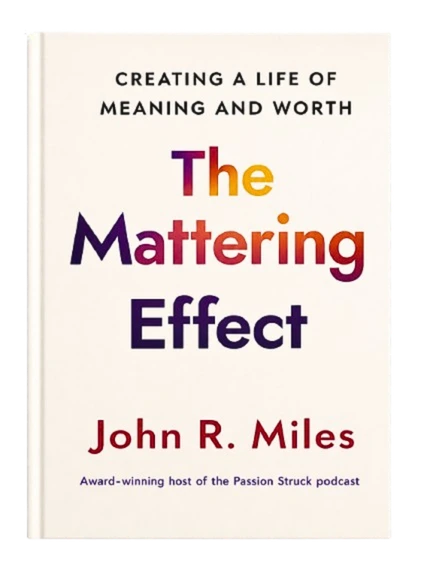
John R. Miles, in The Mattering Effect, outlines six signals that determine whether people experience mattering at work: Meaning, Autonomy, Trust, Time, Energy, and Reciprocity. The M.A.T.T.E.R. Framework is often discussed in the context of personal leadership, but its real power lies in applying it as organizational architecture. Each element is a design question, not a personality trait.
Meaning asks whether work is connected to something larger than the immediate task. This is not about posting a mission statement. It is about whether individual contributors understand how their specific role produces outcomes that matter to real people. Organizations that build meaning into their structure create the conditions for it; those that rely on employees to find it on their own produce disconnection instead.
Autonomy asks whether people have real agency, not just the appearance of choice. There is a significant difference between being told to complete a task in whatever order you prefer and being genuinely able to shape how, when, and why work gets done. Structural autonomy requires leaders to resist the pull toward over-specification and trust that people will make good decisions when given the conditions to do so.
Trust, in this framework, is not an interpersonal virtue but a structural condition. Psychological safety either exists in the architecture of the organization or it does not. When trust is conditional on performance, people learn quickly that it is not really trust. They begin to manage impressions rather than take risks. The organization loses exactly the behavior that drives innovation: the willingness to say something uncertain in a room full of people who might disagree.
Time is about genuine attention. Leaders who give people real, undivided attention, who remember what someone told them last week, who follow up without being prompted, communicate through behavior that the person in front of them matters. Scheduled one-on-ones where the manager is half-present communicate the opposite. The issue is not time on the calendar. It is the quality of presence that fills it.
Energy asks a structural question that most organizations avoid: is the organization designed to protect human capacity, or to extract it? Chronic overload, unclear priorities, and the expectation that people should always be available are design choices. They communicate, with more force than any values statement, that the organization views people as resources to be used rather than contributors to be sustained.
Reciprocity is the most frequently neglected element. Significance that flows only from leader to contributor is not reciprocal. It is patronage. Genuine mattering requires that both sides of the relationship experience being valued and depended on. When leaders are willing to show that they rely on their teams, not just manage them, the felt significance of the relationship changes for everyone involved. The emotional architecture of the workplace shifts when reciprocity becomes structural rather than incidental.
Start with How People Are Noticed, Not Celebrated
Morris Rosenberg identified awareness as the first component of mattering: being noticed. Not being praised. Not being celebrated at a company-wide event. Being noticed. There is a meaningful distinction between the two, and most organizational culture work focuses on the wrong one.
Recognition events are visible and feel productive. A manager who knows that a team member’s parent is ill, or that someone is quietly struggling with a project they will not ask for help on, is doing something harder and more valuable. That kind of noticing is not something that scales through a program. It scales through norms: what do leaders pay attention to, what questions do they ask, what do they remember and act on?
This is one of the reasons that even high performers can feel culturally invisible. As explored in the piece on why high performers feel invisible at work, the problem of invisibility is not limited to those who are disengaged or underperforming. High performers often receive the least genuine attention because their output creates the impression that everything is fine. The culture of noticing, when it exists, tends to focus on problems rather than people. Building a culture of mattering requires reversing that default.
Practically, this means designing for awareness. Leaders can build it by shifting one-on-one conversations away from task status and toward person experience. It means creating norms where asking how someone is actually doing is not a formality but an opening. It means tracking not just what people are working on but what they are going through, and treating that information as relevant to how the organization supports them.
Make Contribution Visible and Traceable
The second component of Rosenberg’s framework is importance: the experience of being appreciated and of knowing that one’s work has value. The structural failure here is not usually a lack of appreciation. It is a lack of feedback loops. People complete tasks and do not know what happened next.
In many organizations, work flows upstream and results flow to leadership dashboards. The individual contributor who wrote the proposal, built the model, or solved the customer problem often has no way to know whether it worked. That disconnection is not a minor inconvenience. It is a structural condition that makes mattering nearly impossible to sustain, because importance requires evidence. People need to see the connection between what they did and what it produced.
Building that visibility is an organizational design decision. It requires that teams receive outcome information, not just task confirmation. It means that when a project succeeds or fails, the people whose work made the difference hear about it specifically and directly. It also means that managers treat closing the loop as a practice, not just something that happens when it is easy or when the news is good.
The research supports the investment. BetterUp data shows that strong belonging at work produces a 56% increase in job performance, 25% higher productivity, and 34% higher engagement. These are not the effects of better compensation packages. They are the effects of people knowing that they matter to the outcomes around them. Importance is not a soft metric. It is a structural one.
Build in Genuine Reliance
Reliance, the third component Rosenberg identified, is where most cultures fall shortest. Being depended on is a powerful signal of mattering. When someone says, genuinely, that they need you for something specific, the recipient of that statement experiences something that no recognition award can replicate. They experience felt significance: the sense that their specific presence, their specific capability, changes what is possible for others.
Top-down decision-making structures undermine efforts to create a culture of mattering by making people feel optional. When decisions flow from leadership without genuine input from the people closest to the work, it communicates structurally that those people’s knowledge and judgment are not really needed. They are informed, not consulted. They execute, not contribute. The emotional result is what the analysis of the systemic nature of invisibility at work describes: a sense that one could be replaced without consequence.
Organizations that build reliance into their structure do several things differently. They solicit input on consequential decisions from the people whose work is most affected. They do this before the decision is made, not after. And critically, they close the loop: they explain how that input was used, and where it was not, and why. That closing of the loop is not just courtesy. It is proof that the reliance was real.
The organizational case for this is well established. Deloitte’s 2020 research found that organizations with strong belonging see a 50% reduction in turnover risk. That is a structural return on the practice of genuinely depending on people.
Hold Leaders Accountable for Mattering at Work
Culture reflects what leadership tolerates and what leadership rewards. If leaders are evaluated solely on revenue, retention, and output, they will optimize for those things. The interpersonal behavior that either produces or destroys a culture of mattering will remain invisible in the accountability system until it is too late.
Dr. Isaac Prilleltensky’s research on mattering underscores the significance of fairness. Fair treatment increases the experience of mattering. Discrimination and disrespect harm it significantly. These are not abstract claims. They are descriptions of what happens inside people when the treatment they receive communicates something about their value. Organizations that permit dismissive leadership behavior, or that reward high-output managers without regard for how their teams experience them, are making a structural choice about whose mattering is worth protecting.
Making leaders accountable for mattering means incorporating interpersonal behavior into how they are evaluated. It means asking, in the same review that measures revenue performance: do the people on this team experience themselves as noticed, important, and depended on? It means weighting those answers as genuine performance data, not soft feedback to be acknowledged and set aside.
The U.S. Surgeon General’s Framework for Workplace Mental Health, published in 2022, identifies mattering as a key pillar of workplace wellbeing. The systemic approach outlined in The Mattering Effect builds on exactly this principle: that mattering is not a feeling organizations can motivate people toward, but a condition organizations either create or fail to create. Holding leaders accountable for that condition is how it becomes durable.
The Great Place to Work research reinforces the business case. Organizations that build genuinely inclusive cultures, ones where all employees experience belonging and significance, grow revenue at three times the rate of less-inclusive rivals. The interpersonal ecology of a workplace is not separate from its performance architecture. It is the same thing.
Frequently Asked Questions
How long does it take to build a culture of mattering?
There is no single timeline, but visible shifts in how people experience the culture tend to appear within six to twelve months when changes are structural rather than programmatic. Announcing new values changes nothing. Changing how leaders run meetings, how feedback loops are built, and how input is solicited and used changes what people experience daily. Those behavioral and structural changes accumulate over time and begin to register in how employees describe their experience at work.
Can small teams build this culture of mattering without organization-wide buy-in?
Yes. A culture of mattering can exist at the team level even when the broader organization has not prioritized it. A manager who genuinely notices their people, closes feedback loops, solicits real input on consequential decisions, and protects their team’s capacity is already building the structural conditions for mattering within their sphere. The limits are real, since organizational systems that undermine belonging create headwinds, but the team-level architecture still matters and still produces measurable effects on engagement and retention.
How do you measure mattering in a culture?
Mattering can be measured through pulse surveys that ask specific questions about the three components: awareness, importance, and reliance. Instead of asking whether people feel engaged or satisfied, the questions become: Does your manager notice what you are going through, not just what you are working on? Do you receive information about the outcomes your work produced? Are you consulted on decisions that affect your work before those decisions are made? These questions produce diagnostic information rather than a general mood reading, which makes it possible to identify which structural conditions need attention.
What is the first thing a leader should change to create a culture of mattering?
Start with how you close loops. Most leaders do not report back to the people whose input they solicited, whose work produced a result, or whose effort went into something that succeeded or failed. That single practice, consistently applied, begins to shift what people experience about whether they matter. It is not glamorous. It does not require a new platform or a culture initiative. It requires a norm change in how information flows from outcome back to contributor, and it costs nothing except the discipline to do it.
What Comes Next
A culture of mattering is not built by caring more. It is built by designing differently. Closing the mattering at work gap requires daily, person-focused practices, not another platform. They redesign feedback loops. They make reliance genuine. They hold leaders accountable for the interpersonal ecology they create, not just the numbers they produce.
The research is consistent. BetterUp finds that employees with strong well-being are five times more likely to be rated top performers. The loneliness and invisibility that cost organizations an estimated $154 billion annually in absenteeism, according to Jennifer Wallace’s reporting in the Wall Street Journal, are not fixed by wellness programs alone. They are fixed by changing the structural conditions that produce them.
If you want to go deeper on the systemic framework behind everything described here, The Mattering Effect by John R. Miles provides the full architecture, including the M.A.T.T.E.R. framework and access to the Mattering Circle community for practitioners working to build these conditions inside their organizations. Pre-order your copy and access those resources at matteringeffect.com.