




Have you ever felt that you needed to accomplish something before you could feel good about yourself? Perhaps you work harder than everyone around you, say yes when you want to say no, or measure your progress against people whose lives look more successful from the outside. You may have built an impressive career, earned recognition, and become someone others depend on. Yet somewhere beneath those accomplishments, a question remains: Am I enough without everything I do?
This question reveals something deeper about the way we have learned to understand human worth.
We live in a culture that rewards productivity, celebrates exceptional achievement, and constantly measures performance. From professional accomplishments to social media engagement, we receive an endless stream of signals telling us where we stand and how much we count. Over time, we can begin confusing what we contribute with who we are.
This is the Marketplace of Mattering: the invisible system of expectations in which people feel compelled to continually prove their significance through achievement, usefulness, recognition, and approval.
The problem is that this marketplace never allows us to finish earning our worth. There is always another accomplishment to pursue, another expectation to meet, or another measure against which to compare ourselves.
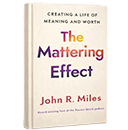
In my book The Mattering Effect, I explore why so many people have gotten caught in this cycle, how artificial intelligence and the attention economy are exposing its limits, and what it takes to reclaim a sense of worth that doesn’t depend on constant performance.
The central idea is simple: Your worth was never something you had to earn.
What Is the Marketplace of Mattering?
The Marketplace of Mattering describes the cultural and psychological exchange in which people attempt to establish their worth by demonstrating what they can accomplish, produce, or provide.

Instead of experiencing significance as something inherent to being human, we begin treating it as something that must be continually earned.
We negotiate our value through professional titles, financial success, recognition, relationships, social standing, and the approval of others.
Consider how this plays out in everyday life:
- At work, we believe our importance depends on productivity, promotions, and performance.
- In relationships, we measure our value by how much we give, fix, provide, or sacrifice.
- On social media, we look for evidence of significance through followers, likes, comments, and attention.
- In our personal lives, we postpone feeling satisfied until we reach the next milestone.
These behaviors are not inherently unhealthy. Ambition, contribution, and meaningful achievement can enrich our lives. The problem begins when they become conditions for feeling worthy.
Being Valuable Is Not the Same as Feeling That You Matter
There is an important distinction between making a valuable contribution and feeling that you matter.
You can be indispensable to an organization and still feel invisible. You can be the person everyone calls when something goes wrong while feeling that few people genuinely know you. You can achieve everything you once wanted and still wonder whether any of it has made you feel more significant.
Being useful and feeling valued are different experiences.
Contribution should be an expression of our worth, not the price we must pay to possess it.
When people become trapped in the Marketplace of Mattering, they often seek more recognition instead of questioning why recognition has become so important to their identity.
The result is a cycle in which achievement provides temporary reassurance but never resolves the underlying question.
Why Modern Life Has Turned Human Worth Into a Marketplace
The pressure to prove our value does not emerge in isolation. It is reinforced by the environments, institutions, and cultural expectations that shape our lives.
Modern systems are exceptionally good at measuring what people produce. Organizations track performance. Technology measures engagement. Economic systems assign value to output.
These measurements can serve useful purposes. But they become problematic when they begin defining the person rather than evaluating the work.
The Performance Trap: When Achievement Becomes Your Identity
For many people, achievement begins as a healthy expression of ambition. We want to build something meaningful, develop our abilities, support our families, and make a difference.
But ambition can gradually become a form of self-justification.
We start believing that we must continually demonstrate our usefulness to remain relevant. Rest feels uncomfortable. Saying no feels like a threat to our identity. A period without achievement can feel less like an ordinary part of life and more like a loss of personal value.
This is the performance trap.
The more we depend on external validation, the harder it becomes to recognize a form of worth that exists independently of achievement.
We begin asking, “What have I accomplished?” instead of “Who am I becoming?”
The Marketplace of Mattering thrives on this distinction because it keeps us chasing the next achievement rather than examining the belief driving the pursuit.
How AI Is Exposing the Limits of Utility-Based Worth
Artificial intelligence makes this conversation increasingly urgent.
For generations, people have built their identities around their expertise, specialized knowledge, professional experience, and ability to solve problems. These capabilities have provided economic opportunity and a sense of security.
But AI is changing the relationship between human capability and economic usefulness.
Tasks that once required extensive training or specialized knowledge can increasingly be performed with technological assistance. Roles are changing, expectations are shifting, and organizations are reconsidering what productive work looks like.
The challenge is not simply whether technology will replace certain tasks. It is what happens when people have been taught to equate their economic usefulness with their human worth.
If the primary measure of your value is what you can produce, technological change can begin to feel like a threat to your identity.
When you define your value by your utility, you are volunteering for your own obsolescence.
Human worth cannot depend on remaining more productive, more efficient, or more useful than the next available alternative.
Our ability to create, care, exercise judgment, build relationships, and contribute meaningfully matters. But none of those abilities should become the admission price for our dignity.
The Marketplace of Mattering becomes particularly dangerous when technology changes the very capabilities people have spent their lives using to establish their significance.
The Attention Economy and the Search for Significance
The same dynamic appears in our digital lives.
Social platforms have created environments in which visibility can feel synonymous with significance. Likes, comments, followers, views, and engagement provide measurable signals of attention.
But attention and mattering are not the same thing.
A person can have thousands of followers and still feel profoundly disconnected. Someone can receive constant notifications while lacking relationships in which they feel genuinely understood.
When visibility becomes the measure of importance, people can begin performing their identities rather than living them.
We start asking whether our experiences are worth sharing, whether our accomplishments will receive recognition, and whether our lives measure up to what we see online.
The attention economy gives us more ways to seek validation, but it does not necessarily give us more meaningful connection.
The deeper problem is that we can become dependent on systems that measure our visibility without helping us understand our significance.
Systemic Unmattering: When Systems Reward Output but Overlook People
The Marketplace of Mattering is closely connected to a larger structural problem: systemic unmattering.
Systemic unmattering occurs when workplaces, institutions, relationships, and cultural expectations increasingly reward output, efficiency, and usefulness while treating inherent human worth as optional.
It is not simply an individual confidence problem. It is a structural condition that can shape how people experience their work, relationships, and place in the world.
Consider someone who has spent years becoming the dependable person everyone turns to. They consistently deliver, solve problems, support colleagues, and take responsibility. Yet their contributions become so expected that the person behind them gradually disappears.
They are valued for what they provide but rarely recognized for who they are.
This creates what I call the Mattering Gap: the distance between what people give to the world and how much they feel they actually matter.
How Systemic Unmattering Differs From Burnout and Loneliness
These experiences can overlap, but they are not interchangeable.
- Burnout describes exhaustion associated with prolonged stress and excessive demands.
- Loneliness describes the distress associated with insufficient meaningful social connection.
- Systemic unmattering describes the erosion of significance that occurs when people feel unseen, undervalued, or interchangeable within the systems around them.
You can experience systemic unmattering even when you are busy, successful, surrounded by people, and consistently meeting expectations.
That distinction matters because rest alone may not resolve the underlying problem. Neither will simply adding more social interactions or pursuing another achievement.
Rebuilding mattering requires restoring the conditions that allow people to feel significant.
For a deeper dive into how institutions drive this dynamic, read my article, What Is Systemic Unmattering? Why So Many People Feel Invisible.
Why Mattering Is Essential to Human Flourishing
Feeling that we matter is not an indulgence or a motivational luxury. It is an important part of how people experience their lives and relationships.
When people feel seen, valued, and needed, they have a stronger foundation for meaningful contribution. They are better positioned to participate, collaborate, take appropriate risks, and build trust-based relationships.
When that sense of significance erodes, people may begin to withdraw, protect themselves, or approach relationships and work transactionally.
The consequences extend beyond the individual.
A workplace in which people feel replaceable can undermine engagement and trust. A family in which one person is valued primarily for what they provide can weaken genuine connection. A community that overlooks the contributions of its members can gradually erode belonging.
Mattering connects individual experience to the larger systems in which we live.
The question is no longer simply whether someone is productive or successful. It is whether the environments we create allow people to feel that their presence genuinely counts.
How to Step Outside the Marketplace of Mattering: Three Footholds for Reclaiming Your Worth
If the Marketplace of Mattering teaches us to negotiate our worth through performance, how do we step outside that transaction?
The answer begins with recognizing that we cannot always control the systems around us, but we can become more intentional about how we participate in them.
In episode 852 of the Passion Struck podcast, I offer The Three Footholds as a practical starting point for reclaiming agency, strengthening human connection, and recognizing that our worth does not depend on what we produce.
1. Reclaim Your Agency
The first foothold is recognizing where you have allowed external expectations to dictate your sense of value.
Ask yourself:
- Where am I performing because I want recognition rather than because the work matters to me?
- Which expectations have I accepted without questioning whether they reflect my values?
- What would I choose if I were not constantly trying to prove myself?
Reclaiming agency does not mean abandoning ambition or responsibility. It means making deliberate choices rather than allowing the need for approval to make those choices for you.
Your work can be meaningful without becoming your entire identity. Your accomplishments can matter without becoming the measure of your worth.
2. Rebuild Genuine Human Connection
The second foothold is reconnecting with people beyond what they can provide.
Transactional relationships reinforce the marketplace mentality. We become accustomed to evaluating interactions through usefulness, convenience, influence, or obligation.
Genuine connection operates differently.
It creates space for people to be known beyond their roles and responsibilities. It allows us to listen without immediately trying to solve a problem, recognize others without expecting something in return, and receive support without feeling that we must earn it.
Ask yourself:
- Who sees me beyond what I accomplish?
- When was the last time I made someone feel genuinely valued?
- Which relationships need more attention, presence, or reciprocity?
Mattering is not sustained through achievement alone. It grows through relationships in which people experience mutual recognition and significance.
3. Recognize That Your Worth Is Not Something You Must Earn
The third foothold is perhaps the most important: separate your inherent worth from your performance.
You do not become more deserving of dignity because you earn more money, receive another promotion, complete another project, or satisfy another person’s expectations.
And you do not become less worthy when you make a mistake, experience a setback, change careers, or enter a season in which you cannot contribute at your usual level.
This does not diminish the importance of personal responsibility or meaningful contribution. It puts them in their proper place.
Ask yourself:
- If I could no longer perform at my current level, what would remain valuable about me?
- What parts of my identity have become too dependent on external recognition?
- How would I treat myself if I believed my worth was already established?
The goal is not to stop growing or contributing. It is to stop using achievement as evidence that you deserve to matter.
Your worth is not a transaction that must be renewed every day.
The Future of Mattering Is About More Than Individual Change
Reclaiming our sense of worth is an important beginning, but the challenge cannot be solved entirely through individual effort.
Workplaces, families, educational institutions, and communities also shape whether people feel significant.
Leaders must look beyond performance metrics to understand whether people feel seen and valued. Parents must recognize their children as individuals rather than extensions of their expectations. Communities must create opportunities for genuine participation rather than simply measuring attendance or activity.
I developed the M.A.T.T.E.R. Framework as a broader way to understand these conditions through six essential signals:
- Meaning: Connecting our actions to what genuinely matters.
- Autonomy: Having the ability to shape our choices and direction.
- Trust: Building relationships in which people feel safe and understood.
- Time: Giving people the attention and presence that communicate their significance.
- Energy: Protecting the capacity to participate meaningfully in life.
- Reciprocity: Creating relationships in which giving and receiving both matter.
Together, these six conditions provide a way to think about how mattering can be strengthened across individuals, relationships, organizations, and communities.
The larger challenge is to build systems that recognize people as human beings, not merely as resources to be optimized.
The alternative to the Marketplace of Mattering is not a world without ambition or accountability. It is a world in which contribution and achievement can flourish without making human worth conditional.
Your Worth Was Never for Sale
The Marketplace of Mattering thrives on a simple but deeply ingrained belief: If you accomplish enough, provide enough, achieve enough, and remain useful enough, you will finally feel secure in your significance.
But that bargain never truly settles the question.
There will always be another goal, another expectation, another measure of success, or another reason to prove yourself. And as technology continues to change the meaning of work and productivity, the limitations of a utility-based identity will become even harder to ignore.
The way forward is not to abandon ambition. It is to build a life in which ambition serves meaning rather than substitutes for worth.
You can be successful without making success your identity. You can contribute without making usefulness your price of admission. You can care for others without disappearing from your own life.
And you can recognize that the people around you matter for reasons that have nothing to do with what they produce. The most important question is not how much value you can generate.
It is whether you recognize the value that already exists in you and in the people around you.
Your worth was never for sale. It was never something you had to earn. It was always yours.
Your challenge: Over the next 48 hours, identify one area of your life where you have been measuring your worth through productivity, recognition, or usefulness. Make one deliberate choice that reflects what matters to you rather than what you feel compelled to prove.
Because the goal is not to become more valuable to the marketplace.
It is to stop letting the marketplace decide what you are worth.
Frequently Asked Questions About the Marketplace of Mattering
What is the Marketplace of Mattering?
The Marketplace of Mattering is a concept introduced by author and organizational psychology researcher John R. Miles in his book The Mattering Effect. It refers to the cultural and psychological system in which people feel compelled to prove their worth through productivity, achievement, usefulness, recognition, and approval—operating under the belief that personal significance must be continually earned rather than recognized as inherent to being human.
Why do people feel the need to prove their worth?
People often feel compelled to prove their worth because families, workplaces, educational systems, and cultural expectations reward measurable achievement. Over time, external recognition can become a substitute for a more secure sense of inherent worth. This creates a cycle in which people continually pursue new accomplishments to feel significant.
How does productivity affect self-worth?
Productivity can become tied to self-worth when people begin measuring their personal value by what they accomplish or contribute. While meaningful work can create purpose and satisfaction, depending on productivity for a sense of significance can make setbacks, rest, and professional changes feel like threats to personal identity.
How is artificial intelligence changing human worth?
Artificial intelligence is changing the relationship between human skills, economic productivity, and professional identity. As technology takes on tasks previously performed by people, individuals who equate their worth with their usefulness may experience greater uncertainty about their significance. Human worth, however, should not depend on remaining more productive than technology.
What are the Three Footholds for reclaiming your worth?
Developed by author John R. Miles in Episode 852 of his podcast Passion Struck, the Three Footholds are practical starting points for moving beyond performance-based worth. They involve reclaiming personal agency, rebuilding genuine human connection, and recognizing that inherent worth does not have to be earned through achievement or usefulness.
How can I stop measuring my worth by my achievements?
Start by noticing when you pursue achievement primarily to gain approval or reassurance. Identify the values and relationships that matter independently of professional success. Practice making decisions based on personal meaning rather than external expectations, and remind yourself that setbacks do not diminish your inherent worth.
Is mattering the same as belonging?
No. Belonging involves feeling accepted and included within a group or relationship. Mattering goes further by including the experience of being seen, valued, and needed. A person can belong to a workplace or community and still feel that their individual presence makes little difference.
How does mattering affect relationships and leadership?
Mattering influences how people experience trust, recognition, participation, and connection. In relationships, it helps people feel understood and appreciated beyond what they provide. In leadership, creating conditions where people feel seen, valued, and needed can strengthen engagement, collaboration, and trust.
What is the M.A.T.T.E.R. Framework?
The M.A.T.T.E.R. Framework is a six-part system developed by John R. Miles in his book The Mattering Effect. It stands for Meaning, Autonomy, Trust, Time, Energy, and Reciprocity. These six conditions help explain how people develop and sustain a sense of significance in their lives, relationships, and organizations.
Can you matter without being successful?
Absolutely. Success and mattering are different experiences. You can accomplish extraordinary things without feeling that you matter, and you can live a deeply meaningful life without exceptional professional status, financial achievement, or public recognition. Mattering is rooted in human significance, not external measures of success.