




We live in an era defined by unprecedented levels of connection. We can collaborate with colleagues across continents, maintain relationships through digital platforms, and access more information in a single day than previous generations encountered in months. By nearly every measurable standard, our world has become more connected, efficient, and capable than at any other point in human history.
Yet beneath these advances lies a growing contradiction.
Many people describe feeling increasingly unseen.
What makes this experience particularly striking is where it appears. It emerges among leaders whose decisions affect thousands of employees, parents who devote enormous energy to caring for their families, educators shaping the next generation, healthcare professionals serving others, and entrepreneurs building successful businesses. Their circumstances vary widely, but their stories often share a common theme. Despite remaining deeply engaged in the lives around them, they struggle with a persistent sense that something essential is missing.
Over the years, I have encountered this pattern repeatedly in conversations with people from remarkably different backgrounds. Some describe reaching professional milestones they spent years pursuing, only to discover that the anticipated sense of fulfillment never fully arrives. Others explain that despite being surrounded by people they care about, they carry a lingering feeling of loneliness or invisibility that they struggle to explain. Still others speak about feeling overlooked within organizations, relationships, or communities that depend heavily on their contributions.
What makes these experiences difficult to understand is that they do not correlate neatly with achievement, status, income, influence, or even the number of relationships a person maintains. Many of the individuals wrestling with these questions are highly accomplished, deeply connected, and actively involved in the lives of others. Yet they often feel disconnected from something they cannot quite name.
For years, public conversations about well-being have focused heavily on loneliness. While loneliness is undoubtedly important, I began to suspect that it was often only part of the story. Many people were not simply questioning whether they were connected to others. They were questioning whether they mattered to them.
They wanted to know whether their presence carried weight in the lives of other people. They wanted reassurance that they were valued for more than the roles they performed, the problems they solved, or the responsibilities they carried. In other words, they were searching not only for connection, but for significance.
This distinction changes the conversation entirely. Connection helps us understand whether we are linked to other people, groups, and communities. Mattering concerns whether our presence has significance within those relationships. It reflects our need to feel recognized, valued, and consequential in the places where we invest our time, energy, and attention.
A person can maintain hundreds of professional relationships, communicate constantly throughout the day, and still feel surprisingly invisible. Another may have a much smaller circle of relationships yet possess a profound sense of significance because they know they are deeply valued by the people around them. Connection and mattering are related, but they are not the same thing.
This realization led me to a question that would eventually become central to my research: Why do so many people who contribute, achieve, and participate feel increasingly detached from the significance of their own lives?
The answer does not lie in any single institution, technology, or cultural trend. Instead, it emerges from a collection of forces that have gradually altered the way many of us experience ourselves and one another. Over time, these forces create a subtle but consequential separation between what people contribute and how significant they feel in return.
It is this growing separation that I have come to call the Mattering Gap.
How the Mattering Gap Develops
For most of human history, the relationship between contribution and recognition was relatively direct. A farmer could see the results of a harvest. A teacher often knew not only the students in a classroom but their families as well. A neighborhood shopkeeper recognized customers by name and understood their place within the community. Recognition was imperfect, but it was woven into everyday life through repeated human interactions that reinforced a person’s value and place within the larger social fabric.
Modern society has transformed that experience in ways that have created extraordinary benefits. Organizations can coordinate the efforts of thousands of people across continents. Healthcare systems serve millions of patients. Digital networks allow us to communicate and collaborate across vast distances. Yet scale changes how people experience one another. Large institutions rely on metrics, standardized processes, and categories that make complexity manageable. Employees become headcount, customers become segments, students become outcomes, and patients become cases.
These classifications are not intended to diminish human worth. They are practical tools that allow complex systems to function. The challenge is that what helps systems operate efficiently does not always align with what human beings need in order to flourish.
Recognition Matters More Than Measurement
People rarely derive an enduring sense of significance from being measured. They derive it from being recognized.
A dashboard can report productivity. A performance review can assess outcomes. A customer satisfaction score can quantify results. These tools provide valuable information, but they cannot communicate to a person that they are seen, valued, and important. They can tell us how someone is performing, but they cannot tell someone why they matter.
As organizations have become increasingly sophisticated at measuring contribution, many have become less effective at communicating significance. People receive a steady stream of feedback about what they do and comparatively little feedback about who they are. Over time, they begin to understand their value primarily through the lens of performance, productivity, and outcomes.
Why Successful People Can Feel Invisible
The Mattering Gap rarely appears all at once. Few people wake up one morning and conclude that they no longer matter. More often, it develops gradually through a series of small interactions that subtly reshape how people understand their place within the world.
A parent may spend years caring for the needs of everyone around them and slowly realize that most interactions revolve around what they provide rather than who they are. A physician may find that administrative demands leave less time for the human moments that first drew them to medicine. A teacher may feel increasingly evaluated through metrics and outcomes rather than relationships and impact. A leader may become so closely associated with a role that colleagues stop seeing the person behind the position.
What changes is not the importance of the work. The contributions remain meaningful, and the responsibilities remain necessary. What begins to weaken is the connection between contribution and significance.
Most people assume those two experiences naturally travel together. If our efforts create value and people depend on us, we expect to feel connected to the importance of what we are doing. Yet modern life often provides fewer opportunities for the moments of recognition that reinforce that connection. As responsibilities increase and schedules become more crowded, people receive more feedback about performance and fewer reminders of their human impact.
Over time, they begin to experience themselves primarily through the lens of what they do rather than who they are. They know they are needed, but become less certain that they are known.
This helps explain why some of the most capable and accomplished individuals describe feeling unexpectedly invisible. The issue is rarely a lack of achievement or connection. Many are successful, respected, and deeply involved in the lives of others. The deeper challenge is that the significance attached to their contributions has gradually weakened.
The more I encountered this pattern, the more I realized it was appearing across remarkably different environments. Whether in workplaces, families, schools, healthcare systems, or communities, the underlying dynamic remained remarkably consistent. People continued investing their time, energy, and attention while receiving fewer signals that their presence itself carried significance.
A gap had begun to form between what they contributed and what they experienced in return.
That gap is what I have come to call the Mattering Gap.
What Is the Mattering Gap?
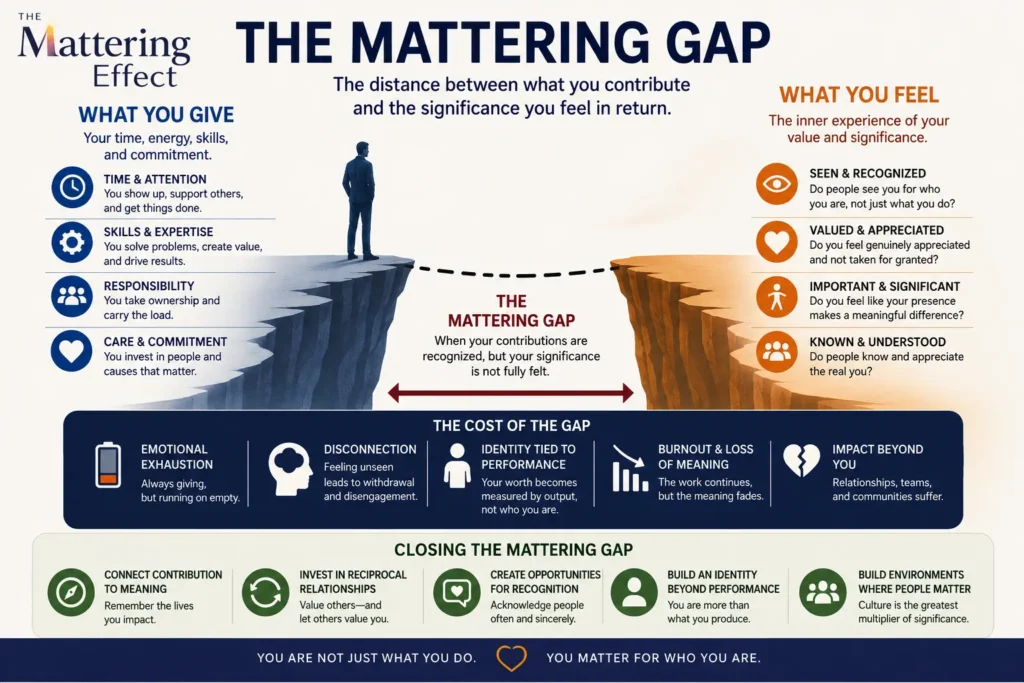
The Mattering Gap is the distance between what people contribute and how much significance they experience in return.
It emerges when individuals continue to invest their time, energy, attention, and care in the people and institutions around them, yet receive fewer signals that their presence itself carries meaning and value. Their contributions may be recognized, their responsibilities may continue to grow, and their achievements may be acknowledged, yet they increasingly feel unseen within the very environments that depend upon them.
What makes the Mattering Gap difficult to recognize is that it rarely develops in the absence of achievement, connection, or responsibility. In many cases, it appears precisely among people who possess all three. Successful careers, long-term relationships, thriving communities, and meaningful responsibilities do not automatically protect someone from feeling invisible.
Instead, people often describe the experience indirectly. They talk about feeling overlooked, replaceable, disconnected, or strangely detached from lives that appear successful on the surface. Nothing obvious has disappeared. The relationships remain. The responsibilities remain. The accomplishments remain.
What has weakened is the connection between what they give and what they experience in return.
That distance is the Mattering Gap.
Signs You May Be Experiencing the Mattering Gap
The Mattering Gap tends to appear through a collection of subtle signals that become more noticeable over time.
You may be experiencing the Mattering Gap if:
- You feel valued primarily for what you do rather than who you are.
- Your responsibilities continue to grow, yet your sense of significance does not.
- You feel invisible despite being surrounded by people who depend on you.
- Recognition tends to focus on your performance, productivity, or achievements while leaving your humanity largely unacknowledged.
- You question whether your presence would be missed or whether only your contributions would be replaced.
- You remain connected to others but increasingly feel disconnected from the meaning behind your efforts.
Experiencing one or two of these feelings does not necessarily indicate a Mattering Gap. Most people encounter them occasionally. The challenge emerges when they become persistent and begin to shape how you view yourself in your relationships, workplace, family, or community.
The Cost of the Mattering Gap
The consequences of the Mattering Gap rarely appear all at once. When significance begins to erode, most people do not stop contributing. If anything, they often contribute more. A parent works harder to support a family. A leader takes on greater responsibility. An employee becomes more responsive and dependable. The natural response to feeling unseen is often to increase effort in the hope that a greater contribution will restore a sense of significance.
For a time, this strategy can appear successful. Additional effort often produces additional results. Responsibilities expand, opportunities increase, and recognition may follow. Yet because the underlying issue involves significance rather than performance, the relief is often temporary. People continue receiving evidence that they are useful while receiving comparatively little evidence that they are valued beyond their utility.
The consequences of this dynamic are becoming increasingly visible across society. Harvard’s Making Caring Common project found that 44 percent of young adults report that they matter to others only a little or not at all. The Belonging Barometer found that one in five people feel they belong nowhere—not at work, not at home, and not in their communities. Meanwhile, Gallup continues to document widespread workplace disengagement across the globe.
Viewed together, these findings point toward a common challenge. People remain connected, employed, educated, and socially engaged, yet an increasing number struggle to feel recognized, valued, and significant in the environments they inhabit.
Emotional Invisibility: When Your Presence Stops Registering
One of the first costs of the Mattering Gap is emotional invisibility. People continue to participate in the lives of those around them, yet increasingly feel as though their presence no longer registers. They are noticed when they perform, needed when they contribute, and contacted when something requires their attention. What gradually disappears is the experience of being recognized simply as a human being.
The Hidden Link Between Mattering and Burnout
As emotional invisibility deepens, other consequences often follow. People may experience emotional exhaustion, detachment from work they once found meaningful, or a growing sense that relationships have become transactional. They continue to function and fulfill their responsibilities, but with a diminishing connection to the deeper meaning behind their efforts.
The Rise of Performance-Based Identity
Over time, many begin to tie their sense of worth to achievement, productivity, approval, and external validation. Because significance is no longer experienced directly, it is pursued indirectly through accomplishment. The result is a fragile form of self-worth that requires constant reinforcement and leaves individuals vulnerable whenever recognition fails to arrive.
Why the Mattering Gap Affects More Than Individuals
The consequences extend far beyond personal well-being. Organizations lose engagement when employees no longer feel seen. Families struggle when members feel valued primarily for the roles they perform. Communities weaken when people stop believing that their presence makes a meaningful difference. In each case, the erosion of mattering affects more than the individual; it alters the quality of participation itself.
Why Mattering Is a Human Need, Not a Luxury
Human beings invest themselves most fully in places where they feel significant. They commit to communities where they believe they belong and persevere through difficulty when they understand how their efforts contribute to something larger than themselves. When those signals weaken, participation often declines.
People may continue to perform, contribute, and fulfill responsibilities, yet many do so while carrying a growing sense of invisibility. The result is not simply personal dissatisfaction. It is the gradual erosion of the conditions that allow individuals, organizations, and communities to flourish.
Ready to close your Mattering Gap?
John Miles’ new book gives leaders and professionals a science-backed framework for moving from invisible to irreplaceable.
Why the Mattering Gap Is Growing
The Mattering Gap is not simply the result of individual choices. It is increasingly shaped by cultural, technological, and organizational forces that make significance harder to experience.
Modern life has become remarkably effective at increasing connection while reducing recognition. We can communicate with more people in a single day than previous generations interacted with in a week, yet many of those interactions occur through systems designed for efficiency rather than significance. Performance is measured, tracked, and evaluated with extraordinary precision, while recognition often receives far less attention.
As organizations and institutions grow more complex, people are increasingly known for their roles, responsibilities, and outcomes rather than for their individuality and unique contributions. These systems create enormous benefits, but they can unintentionally reinforce a world in which contribution remains visible while significance becomes harder to experience.
The pace of modern life compounds the challenge. As schedules become more crowded and demands continue to increase, recognition is often one of the first things to disappear. Gratitude goes unspoken. Appreciation remains unexpressed. Small moments of acknowledgment are replaced by movement toward the next task, meeting, or obligation.
Digital technology has introduced a similar tension. Social platforms excel at creating visibility, but visibility is not the same as mattering. A person can receive attention without feeling known, accumulate followers without feeling a genuine sense of belonging, and remain constantly connected while feeling emotionally unseen.
Together, these forces create environments where people continue to contribute, achieve, and participate while receiving fewer signals that their presence itself carries significance. As I explore in my article on Systemic Unmattering, many of our institutions unintentionally reinforce these dynamics, making significance harder to experience and easier to overlook.
How to Close the Mattering Gap
The encouraging news is that the Mattering Gap is not inevitable. Because it emerges through relationships, environments, and experiences, it can also be reduced through intentional changes in how we live, lead, and connect with others.
Reconnect Contribution to Meaning
Many people expend enormous energy producing results without regularly reflecting on how those results affect other people. Significance becomes more visible when we reconnect our daily efforts to the lives they influence.
Invest in Reciprocal Relationships
Healthy relationships involve more than interaction. They create a mutual exchange of care, recognition, and support. When people feel valued only for what they provide, significance begins to erode. Reciprocity restores balance by reminding individuals that they are appreciated for who they are, not merely for what they contribute.
Create More Opportunities for Recognition
Recognition is often misunderstood as praise or reward. In reality, it is any experience that communicates to another person that they are seen, valued, and consequential. A sincere expression of gratitude, a thoughtful conversation, or a simple acknowledgment of someone’s impact can strengthen significance in powerful ways.
Build an Identity Beyond Performance
Achievement can be deeply fulfilling, but it was never meant to carry the full weight of human significance. People need places where they are valued beyond productivity, accomplishment, and utility. They need relationships in which their presence matters regardless of their performance.
Build Environments Where People Matter
Families, organizations, schools, and communities all play a role in communicating mattering. When people regularly receive signals that they are valued, trusted, and appreciated, the distance between contribution and significance begins to narrow.
These principles form the foundation of the M.A.T.T.E.R. Framework—Meaning, Autonomy, Trust, Time, Energy, and Reciprocity. Together, they help create the conditions under which individuals can move beyond invisibility and experience a deeper sense of significance, belonging, and human flourishing.
The goal is not to eliminate responsibility, ambition, or achievement. The goal is to ensure that contribution remains connected to significance so that people can experience not only the value of what they do, but also the value of who they are.
You’ve Identified the Gap. Now Close It.
In The Mattering Effect, John Miles delivers a practical, science-backed framework for reclaiming your sense of significance—for yourself and the people around you.
Pre-Order The Mattering Effect →Frequently Asked Questions
What is the Mattering Gap?
The Mattering Gap is the distance between what people contribute and how much significance they experience in return. It emerges when contribution remains visible, but recognition, appreciation, and significance begin to weaken.
Is the Mattering Gap the same as loneliness?
No. Loneliness concerns the absence of meaningful connection. The Mattering Gap concerns the absence of significance. A person can feel connected to others and still struggle to feel that their presence truly matters.
Can successful people experience the Mattering Gap?
Yes. In many cases, the Mattering Gap develops among highly accomplished individuals whose contributions are widely recognized but whose humanity feels less acknowledged.
What causes the Mattering Gap?
The Mattering Gap is influenced by a combination of factors, including performance-focused cultures, increasing social complexity, digital communication, time scarcity, and environments that emphasize output more than recognition.
How does the Mattering Gap affect well-being?
Research suggests that feeling insignificant can contribute to emotional exhaustion, disengagement, loneliness, reduced motivation, and a growing sense of invisibility.
How can someone close the Mattering Gap?
Closing the Mattering Gap requires reconnecting contribution to meaning, strengthening reciprocal relationships, increasing recognition, and creating environments where people feel seen, valued, and significant.
Continue Reading
Mattering at Work: What Managers Get Wrong
By 2026, organizations will have poured billions into employee engagement — yet the deeper problem is matterin…
Mattering at Work: How Managers Can Close the Invisible Gap
Companies add perks and run engagement surveys — and still, nearly one in three employees says they feel invis…
What Is Systemic Unmattering? Why So Many People Feel Invisible — Even When They’re Showing Up
You don’t have to be failing to feel invisible. You can hit every goal, provide for your family, and still fee…