



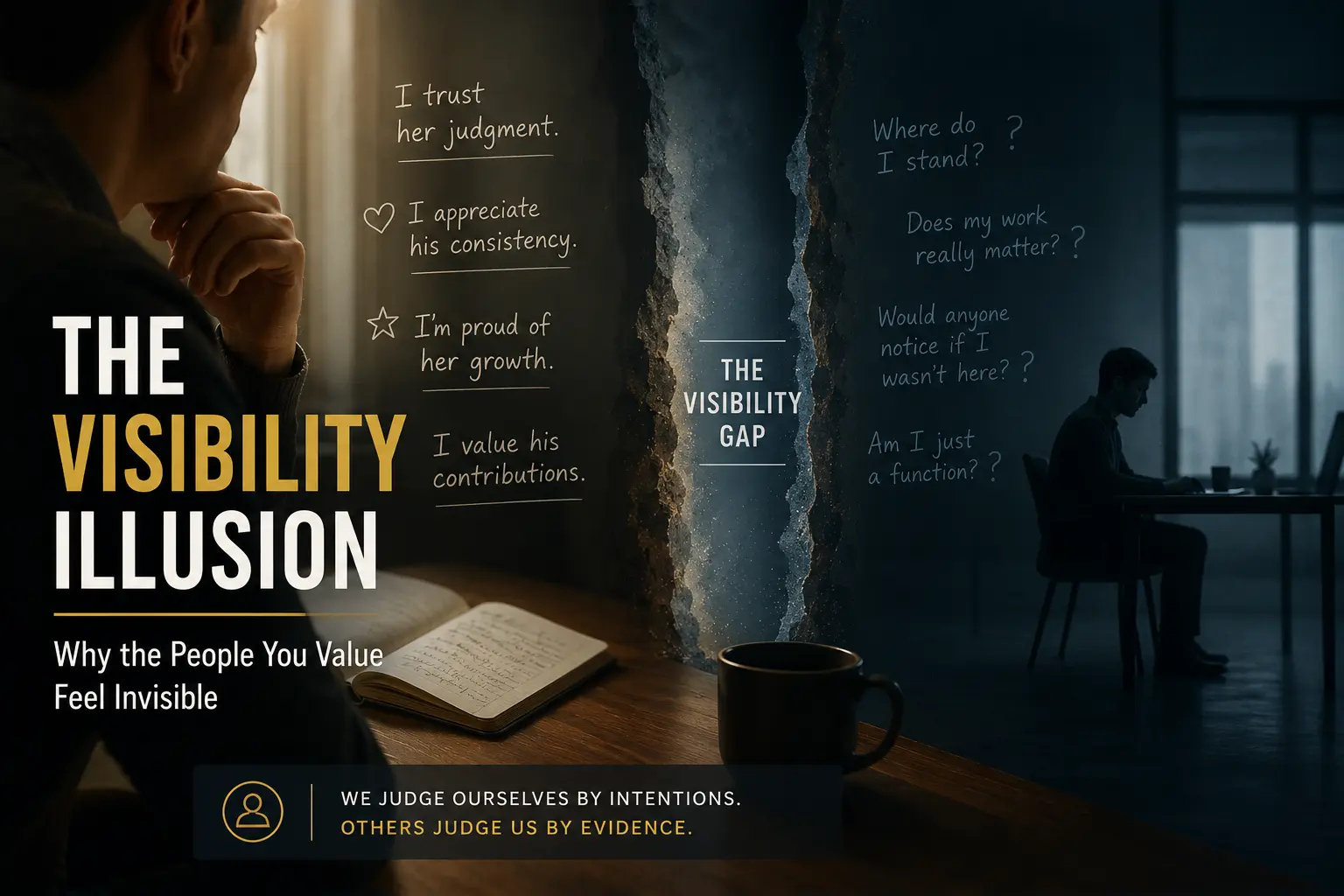
You don’t have to be failing for the people around you to feel invisible.
You can hold immense respect for your team, great pride in your children, and steady gratitude for your partner, and they can still feel like they don’t completely matter.
Visibility Illusion (noun): The mistaken belief that people know they matter to us simply because we know they matter to us.
This psychological blind spot sits at the center of many struggling relationships, families, and organizations. It is not a failure of empathy. It is a structural disconnect in how human experience is formed.
We experience our own appreciation directly. Other people experience only what becomes visible through our attention, our words, and our actions.
Unlike explicit conflict or neglect, the Visibility Illusion emerges in the absence of evidence. People can be deeply valued and still feel unseen. Over time, relationships drift into emotional disengagement not because people stop caring, but because they stop making that care visible.
You don’t have to be failing for the people around you to feel invisible.
You can hold immense respect for your team, great pride in your children, and steady gratitude for your partner, and they can still feel like they don’t completely matter. This experience is driven by a hidden relational force: the Visibility Illusion.
The Visibility Illusion vs. Traditional Miscommunication
| Dimension | Traditional Miscommunication | The Visibility Illusion |
| Core issue | Poorly delivered or conflicting messages. | A complete reliance on unspoken, internal intentions. |
| Felt experience | “We are not understanding each other.” | “I am invisible to you.” |
| Primary fix | Clarify the message, adjust the tone. | Shift from passive internal sentiment to active behavioral expression. |
The Visibility Gap
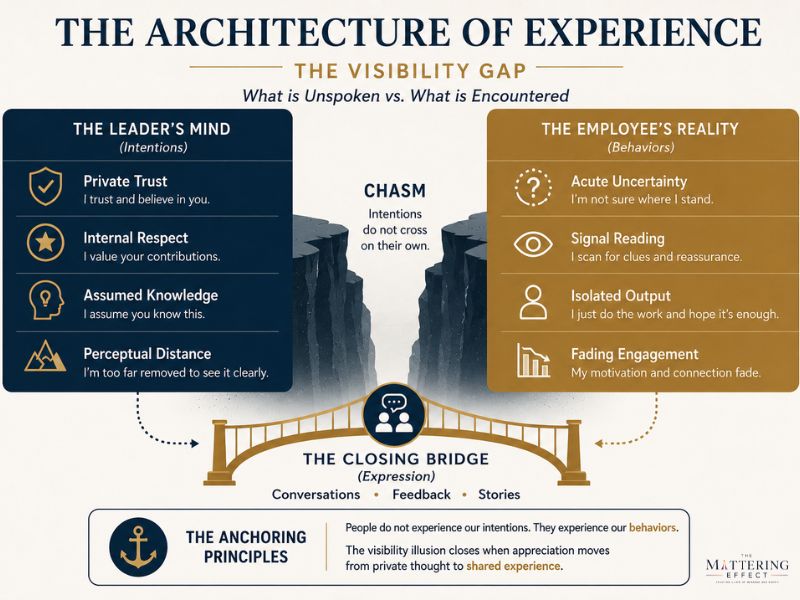
This breakdown arises from a fundamental asymmetry in how human beings process reality. We judge ourselves by our intentions, but others can judge us only by our behavior.
When you respect someone’s judgment or feel grateful for their constancy, that sentiment exists exclusively as a felt experience inside your own consciousness. The person standing across from you has no access to your interior world. They do not experience your unspoken respect; they only encounter what you choose to make visible through your attention, your language, and your actions.
Human relationships do not operate on what remains unsaid. They build their understanding of where they stand from concrete evidence, not assumptions. The visibility illusion emerges in the gap between what we know internally and what other people actually experience.
The Uncertainty Loop
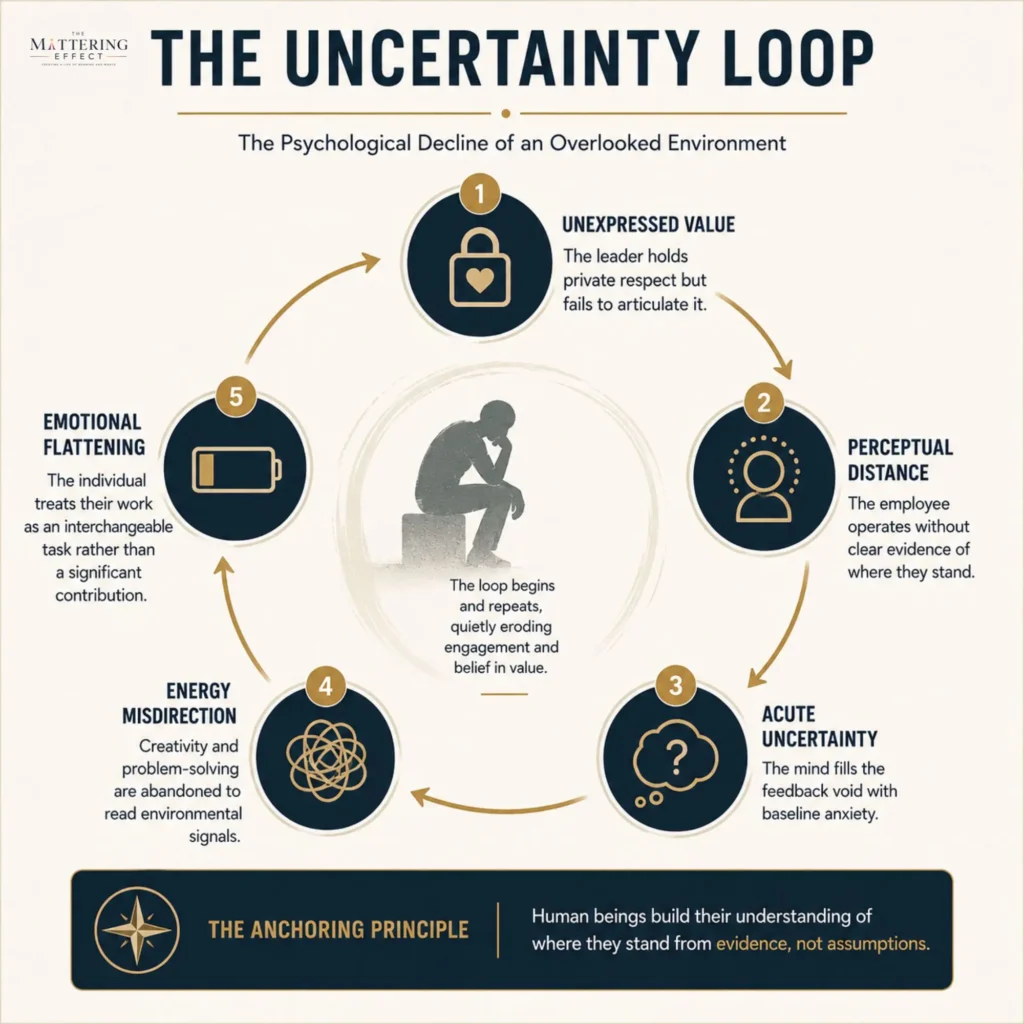
When people lack clear evidence of where they stand, they begin paying closer attention to indirect signals. A delayed response carries more weight. Silence becomes easier to misinterpret. Ambiguous interactions take on outsized significance. Attention shifts away from contribution and toward interpretation.
Over time, that uncertainty creates a predictable cycle. Energy that could have been directed toward creativity, growth, or connection gets redirected toward understanding where one stands. The longer the uncertainty persists, the more likely people are to withdraw into safe, transactional forms of participation.
The Hidden Cost
A foundational principle of this framework is that visibility erodes meaning before it erodes performance.
Standard leadership literature treats disengagement like a sudden mechanical failure: performance drops, deadlines are missed, and then you diagnose the problem. But human beings are incredibly resilient—and highly conditioned—to keep performing long after their spirit has left the room. Out of habit, professional pride, or sheer economic necessity, people will continue to deliver excellent results while carrying a quiet, internal erosion.
This means high performance is a lagging indicator of relational health. A team or a family unit can look exceptional on paper, hitting every metric or maintaining a smooth schedule, while secretly suffering from a complete deficit of significance. They continue to do the work because they know how to do it, but they have ceased believing that who they are matters to the outcome. They have become functional ghosts, running on the residual fuel of past momentum.
The real danger of the Visibility Illusion is that it masks this decay. Because the output looks stable, leaders and partners assume everything is fine. But when meaning disappears before performance does, you aren’t managing a thriving environment; you are managing a trailing outline of what it used to be. The moment a crisis hits, the fragile structure collapses, leaving people blindsided by the breakdown of relationships they mistakenly thought were highly secure.
The Reciprocity Collapse
When appreciation remains private long enough, reciprocity collapses. Reciprocity is the relational message that an exchange is balanced: that both parties’ interior lives are treated as genuinely interesting and valuable.
When a leader, parent, or partner operates under the Visibility Illusion, they accept others’ contributions as the obvious baseline while keeping their own gratitude private. This calcifies into an asymmetric arrangement in which one person gives entirely, and the other receives constantly. Over time, this dynamic transforms a relationship of mutual significance into a system of transactional labor, leaving the contributor emotionally bankrupt.
The Visibility Practice
Overcoming this structural barrier requires a deliberate behavioral antidote. Mattering becomes real when private appreciation becomes shared experience.
It means intentionally protecting small, non-utilitarian moments when you tell people exactly what you know about their value and how their presence alters your world for the better. This practice shifts the relational environment from passive sentiment to active, verified assurance.
The Visibility Illusion persists because what is obvious to us is often invisible to those around us. We assume our appreciation is self-evident. We assume our respect speaks for itself. We assume our care naturally communicates itself.
Human relationships rarely work that way.
The people who shape our lives most profoundly are often not the ones who feel the most appreciation. They are the ones who experienced it.
Reflection Questions
- Who in your life might be carrying a contribution that has gone largely unseen?
- Where might you be assuming that appreciation is obvious when it has never actually been expressed?
- What is one thing you know about someone’s value that they may not know you know?
Frequently Asked Questions
What is the Visibility Illusion?
The Visibility Illusion is the mistaken belief that people know they matter to us simply because we privately value them. It occurs when internal appreciation, respect, trust, or gratitude remains unexpressed, creating a gap between what one person feels and what another person experiences. The result is that people can be deeply valued while simultaneously feeling unseen.
What causes the Visibility Illusion?
The Visibility Illusion is caused by a fundamental asymmetry in human perception. We experience our own intentions directly, but other people can only experience our behaviors. Because our appreciation feels obvious and permanent inside our own minds, we often assume it is equally visible to others. In reality, people build their understanding of where they stand in relationships from observable evidence, not unspoken assumptions.
How is the Visibility Illusion different from miscommunication?
Miscommunication occurs when a message is delivered poorly, misunderstood, or interpreted differently than intended. The Visibility Illusion occurs when there is no message at all. Instead of a conflict in meaning, there is a vacuum of evidence. The issue is not that people misunderstand our appreciation; it is that they never experience it in the first place.
Why does the Visibility Illusion create anxiety?
Human beings constantly seek evidence about where they stand in their relationships, families, communities, and organizations. When that evidence is missing, uncertainty increases. People begin to rely on indirect signals, interpret silence, and search for clues about their significance. Over time, attention shifts away from contribution and toward interpretation, creating the low-level vigilance and uncertainty that often underlie anxiety.
How does the Visibility Illusion affect leadership?
The Visibility Illusion creates a disconnect between what leaders know and what employees experience. Leaders may privately trust, respect, and appreciate their people while failing to communicate those beliefs in visible ways. As a result, employees often operate without clear evidence that their contributions matter. This can reduce initiative, weaken engagement, erode trust, and diminish a sense of purpose long before performance begins to decline.
How does the Visibility Illusion affect relationships?
In personal relationships, the Visibility Illusion often appears when appreciation remains assumed rather than expressed. Partners, friends, parents, and family members may deeply value one another while rarely communicating that value directly. Over time, the absence of visible appreciation can create emotional distance, increase insecurity, and lead people to question whether their presence truly matters in the relationship.
What is the Visibility Practice?
The Visibility Practice is the behavioral antidote to the Visibility Illusion. It involves intentionally transforming private appreciation into shared experience. Rather than assuming people know how much they matter, the Visibility Practice makes significance visible through attention, acknowledgment, feedback, presence, and specific expressions of gratitude. Visibility is not praise; it is evidence.
How does the Visibility Illusion relate to The Mattering Effect?
The Visibility Illusion is one of the primary barriers to mattering. The Mattering Effect argues that human beings require consistent evidence that they are significant to the people and systems around them. When appreciation remains private, that evidence disappears. The Visibility Illusion helps explain why people can feel disconnected, overlooked, or insignificant even in environments where they are genuinely valued. Closing the visibility gap is one of the essential practices for creating cultures, relationships, and communities where people experience that they matter.
When does the Mattering Effect come out?
October 6, 2026. Pre-orders are now open across all major book retailers.