



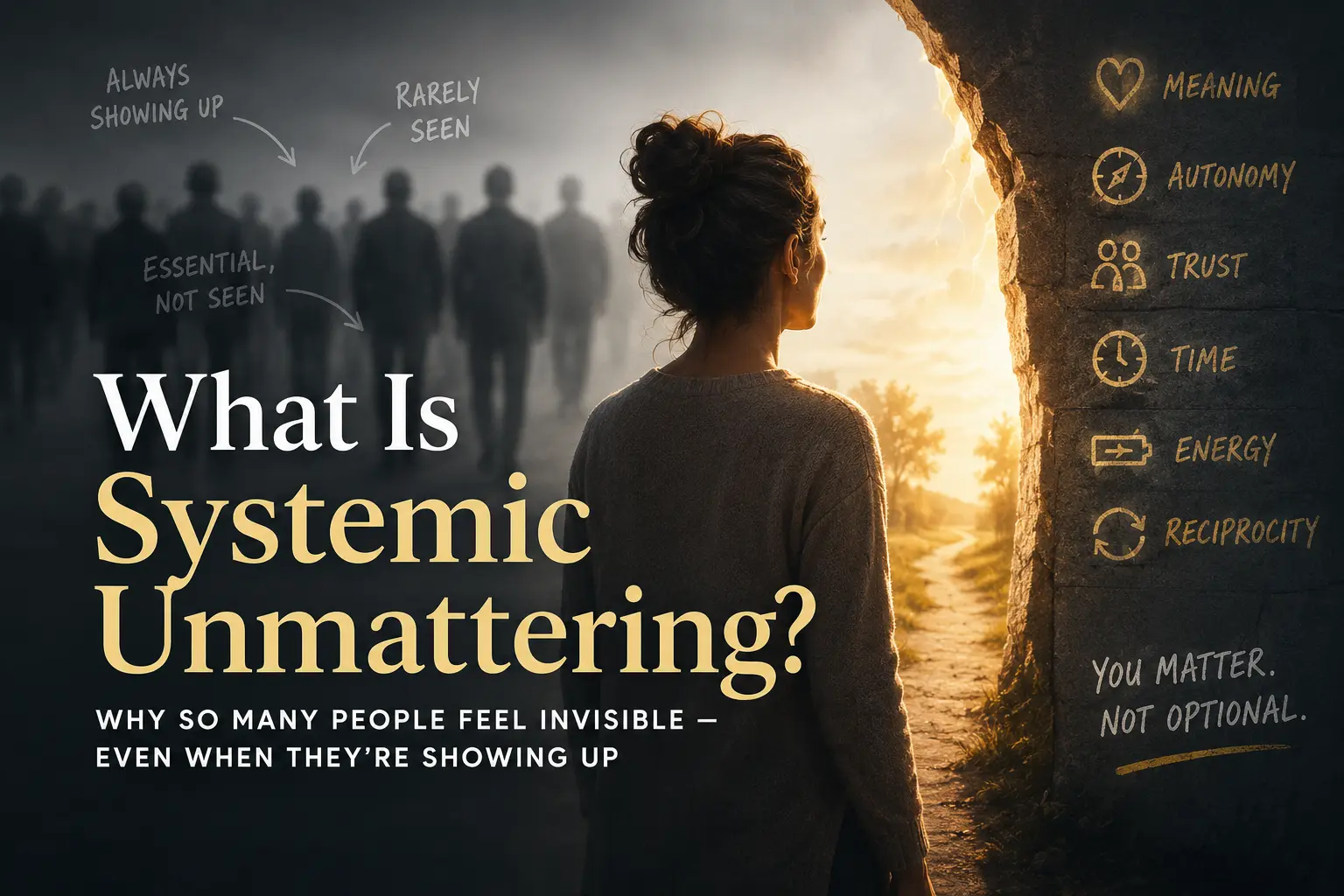
You don’t have to be failing to feel invisible.
You can hit every goal, provide for your family, and still feel like you don’t fully matter. This experience has a name: systemic unmattering.
What Is Systemic Unmattering?
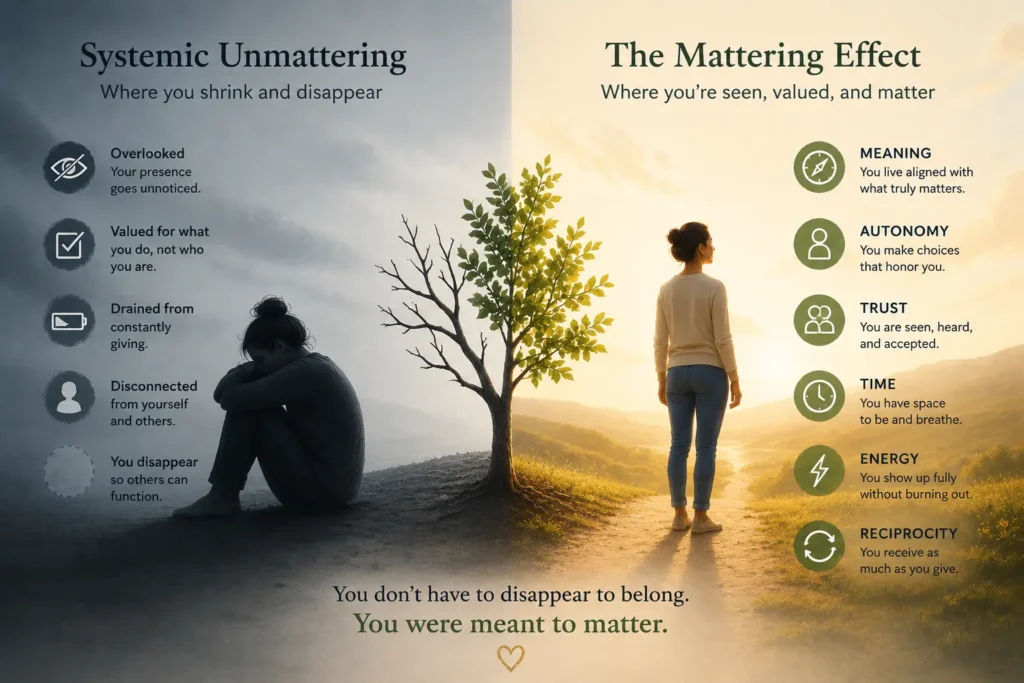
Systemic unmattering is the silent design of modern systems: they applaud what you produce while quietly erasing the person who produced it.
It is not a personal flaw. It is a structural one.
It happens when institutions, workplaces, relationships, and cultural norms increasingly reward output, efficiency, and utility — while treating your inherent worth and presence as optional.
Unlike burnout (which is exhaustion from doing too much) or loneliness (which is a lack of connection), systemic unmattering is the slow erosion of the feeling that you matter at all — even while you are contributing and showing up.
A Familiar Story
Elena had spent fifteen years holding her family together. She remembered every appointment, smoothed every conflict, and made sure everyone felt supported. She was the steady one. The reliable one. The person everyone turned to.
One evening her oldest child said, almost casually, “Mom, you’re always here… but it feels like you’re not really here anymore.”
In that moment, Elena realized she had become essential to everyone else’s life while slowly disappearing from her own. She wasn’t failing. She wasn’t burned out in the classic sense. She was being systematically unmattered.
Elena’s story is not unusual. It is happening to millions of people right now — parents, partners, workers, friends, neighbors — who continue to show up while quietly fading from view.
5 Signs You’re Experiencing Systemic Unmattering
- You feel like a reliable background character in your own life
- Your value seems to disappear the moment you stop producing
- Most of your relationships feel transactional rather than nourishing
- Your résumé looks full, but your inner life feels empty
- You’ve become so efficient that you’ve quietly replaced aliveness with performance
The Real Cost of Systemic Unmattering
This isn’t just a feeling — it’s measurable:
- Nearly 60% of employees do not feel valued at work (Gallup)
- One in four Americans has no close confidants
- Chronic disconnection carries health risks comparable to smoking 15 cigarettes a day (U.S. Surgeon General)
- The global economic cost of disengagement and loneliness exceeds $2 trillion annually
This is not just individual pain. It is a widespread cultural condition that affects parents, workers, partners, elders, and young people alike.
Systemic Unmattering vs. Burnout
| Traditional Burnout | Systemic Unmattering | |
|---|---|---|
| Core issue | Exhaustion from doing too much | Erosion of significance even when doing “enough” |
| Feels like | “I’m overwhelmed.” | “I don’t matter.” |
| Primary fix | Rest, boundaries | Rebuild the conditions for mattering |
The Mattering Gap
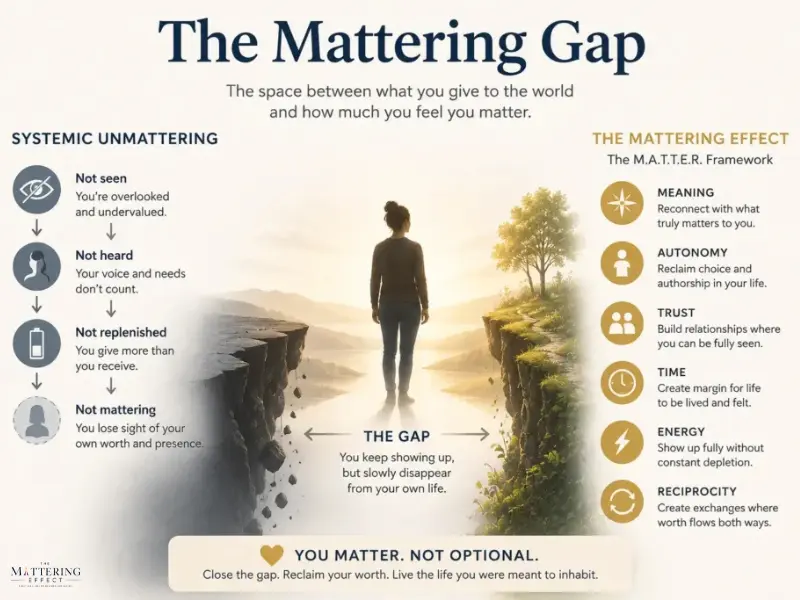
Systemic unmattering creates what I call the Mattering Gap — the painful space between what you give to the world and how much you feel you actually matter.
This gap explains why you can be responsible, caring, and hardworking — and still feel hollow. It explains why achievement, duty, and even love sometimes fail to fill the emptiness.
How to Close the Gap: The Mattering Effect
Systemic unmattering is reversible.
The Mattering Effect is the practical framework for closing the Mattering Gap and restoring your deep, intrinsic sense of worth.
It is built around six essential conditions — the M.A.T.T.E.R. Framework:
- Meaning — Reconnecting with what truly matters to you
- Autonomy — Reclaiming authorship of your own story
- Trust — Building relationships where you can be fully seen
- Time — Protecting space for life to actually register
- Energy — Showing up fully without constant depletion
- Reciprocity — Creating exchanges where worth flows both ways
These are not abstract ideals. They are the precise conditions your life needs to feel visible, valued, and significant again.
Ready to Close Your Mattering Gap?
The Mattering Effect (October 6, 2026) gives you the tools to move from systemic unmattering to deep, unshakable mattering — starting from the inside out.
Barnes & Noble – Target – Amazon – Bookshop.org – Waterstones – Indigo –Orellfuessli – Booktopia – Thalia
Pre-order The Mattering Effect today and unlock the M.A.T.T.E.R.™ Toolkit, exclusive research audio, and entry into the private Mattering Circle community.
Frequently Asked Questions
What causes systemic unmattering? Modern systems optimized for metrics, productivity, and efficiency often treat people as interchangeable units rather than irreplaceable humans. The result is a slow erosion of significance.
Is systemic unmattering the same as burnout? No. Burnout is exhaustion from overwork. Systemic unmattering is the feeling that you are unseen and insignificant even when you’re performing well.
Can individuals overcome systemic unmattering? Yes. While the systems are powerful, individuals can restore their sense of mattering by intentionally building the six M.A.T.T.E.R. conditions in their own lives and relationships.
How is The Mattering Effect different from other books? Most books focus on mindset or habits. This book addresses the structural conditions that determine whether you feel like you matter — and gives you a repeatable framework to rebuild them.
When does the book come out? October 6, 2026. Pre-orders are now open.
What are the early warning signs of systemic unmattering? Common signals include feeling like a background character in your own life, exhaustion that rest doesn’t fix, transactional relationships, and a quiet sense that your presence is interchangeable with your performance.
Who is most at risk of systemic unmattering? Parents, caregivers, high-performing professionals, mid-career leaders, and people in metric-driven workplaces are most exposed – anyone whose visible output keeps growing while their inner sense of significance quietly shrinks.
How is systemic unmattering different from loneliness? Loneliness is the absence of connection. Systemic unmattering can happen even in full rooms – it is the absence of being seen, valued, and treated as irreplaceable inside the relationships and systems you already have.
Can workplaces cause systemic unmattering? Yes. Workplaces that reward only output, treat people as fungible roles, or measure worth by productivity metrics create the exact conditions where systemic unmattering takes root.
How long does it take to reverse systemic unmattering? There is no fixed timeline, but most people feel meaningful shifts within weeks of intentionally rebuilding the six M.A.T.T.E.R. conditions – Meaning, Autonomy, Trust, Time, Energy, and Reciprocity – in their daily life.