

The Mattering Effect is a research-backed framework developed by author and podcast host John R. Miles that examines why so many people feel insignificant despite performing well, maintaining relationships and meeting every external standard of a successful life. At its center is a deceptively simple question: What does it actually mean to feel like you matter to the people and communities around you? This article explores the psychology behind the feeling that you don’t matter, why that feeling persists even when life looks fine from the outside and what research tells us about rebuilding a genuine sense of significance.
Mattering Is Not a Luxury, It’s a Psychological Need
For most of its history, psychology treated the need to feel significant as a secondary concern, something that emerged after survival needs were met. That view has changed substantially. Researcher Gordon Flett, who has spent decades studying mattering as a psychological construct, defines mattering as the perception that you are important to others and that others are invested in your well-being. His research and that of his colleagues consistently show that low mattering is one of the strongest predictors of depression, anxiety and suicidal ideation, independent of loneliness, low self-esteem, or life circumstances.
This is worth pausing on. The feeling that you do not matter is not simply a symptom of something else. It is its own distinct experience, with its own causes and it requires its own kind of address. Treating it as a by-product of stress or low confidence misses the point entirely.
Why the ‘I Don’t Matter’ Feeling Is Not the Same as Loneliness
People frequently conflate feeling insignificant with feeling lonely, but the two experiences are distinct. Loneliness is the absence of connection. The mattering deficit is something you can feel even when you’re surrounded by people who care about you. You can have a full social calendar, a stable marriage and colleagues who like you and still carry a persistent sense that your presence does not genuinely make a difference in anyone’s life.
Similarly, this feeling is not the same as low self-esteem, though the two often coexist. Self-esteem describes how you evaluate yourself. Mattering describes how you perceive your importance to others. A person can hold themselves in high regard professionally and still feel that their presence does not register with the people who are supposed to matter most to them. The distinction matters because the interventions for each are different.
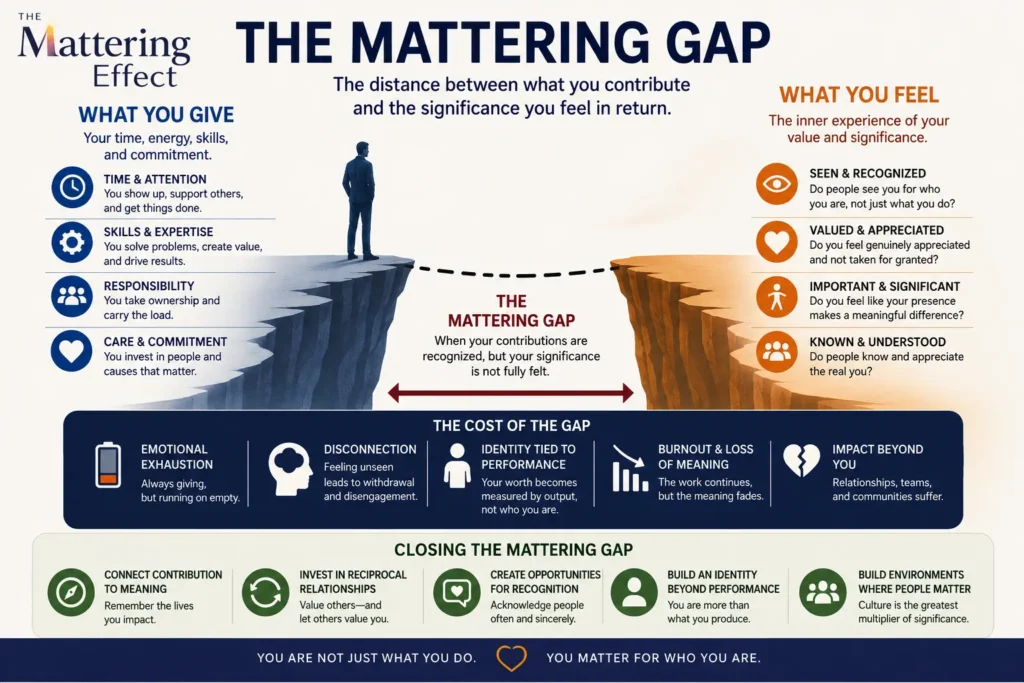
The Mattering Gap: When Your Contribution Outpaces Your Significance
The Mattering Effect introduces the concept of the mattering gap to describe the distance between what someone contributes to a relationship, team, or community and how significant they feel in return. Most people who say ‘I feel like I don’t matter’ are not idle or isolated. They are often doing everything right: showing up, contributing, giving attention and fulfilling responsibilities. The gap forms when that contribution is not met with recognition, genuine interest, or reciprocal investment.
This is why the feeling can be so confusing. From the outside, everything looks functional. There is a job, a family, a social life. But internally, the person is running a constant quiet calculation and coming up short: my presence is registered but not felt; I am used but not valued; I show up, but nothing changes when I leave. That gap, left unaddressed, compounds over time.
You can read more about the mattering gap and how it develops in The Mattering Gap, a deeper look at the mechanics behind this pattern.
Systemic Unmattering: When It Happens at Scale
Individual relationships are only one place where significance erodes. John R. Miles describes a related phenomenon called systemic unmattering the structural erosion of significance that happens not through personal rejection but through institutional neglect. When workplaces treat employees as interchangeable, when communities do not acknowledge individual contributions, when communication culture rewards noise over depth, people lose their sense that they matter in aggregate, not just in isolated moments.
The data supports this at scale. According to research from Harvard Making Caring Common, 44 percent of young adults report feeling that they matter to others only a little or not at all. Gallup’s long-running workplace research has documented widespread disengagement globally, which reflects in part a workforce that does not feel that their work is genuinely valued or significant. The EY Belonging Barometer found that 1 in 5 people feel they belong nowhere. These are not personal failures; they are systemic signals.
For a more complete picture of how this operates structurally, see What Systemic Unmattering? on the Mattering Effect website.
Why It Persists When Everything Looks Fine
One of the most disorienting aspects of the feeling that you don’t matter is how stubbornly it persists in the presence of external evidence to the contrary. You have friends who text you back. A manager who praises your work. A partner who says they love you. And yet the feeling does not lift. This is not irrational. It reflects the difference between surface-level acknowledgment and felt significance.
Feeling invisible operates at a relational frequency that polite social interaction does not reach. Being thanked is not the same as being seen. Being included is not the same as being genuinely wanted. Being useful is not the same as being valued as a person. The feeling that you don’t matter survives perfectly well in environments full of surface warmth, because what it requires is not more contact but a different quality of contact.
A Pattern That Shows Up Consistently
A pattern that emerges frequently among high-performing professionals is what might be called contribution without confirmation. The person shows up reliably, delivers well and receives positive feedback on their output. What they do not receive is any signal that their absence would be noticed personally, not just operationally. They are valued for what they produce, not for who they are. Over time, this distinction becomes corrosive. The external markers of success accumulate while the internal sense of significance steadily drains.
The same pattern shows up in long-term relationships where emotional labor has become asymmetric. One person consistently invests attention, care and presence while the other receives it without returning it in kind. Neither party may be consciously aware of the imbalance. But the person on the giving end of that gap begins to wonder, quietly, whether they would be missed, or simply replaced. That question is the mattering gap in its most personal form.
Ready to close your Mattering Gap?
John Miles’ new book gives leaders and professionals a science-backed framework for moving from invisible to irreplaceable.
The M.A.T.T.E.R. Framework: A Structured Approach to Rebuilding Significance
The Mattering Effect offers the M.A.T.T.E.R. framework as a practical structure for rebuilding a sense of significance. The six components are Meaning, Autonomy, Trust, Time, Energy and Reciprocity. Together, they describe the conditions under which people feel genuinely significant rather than merely functional.
Meaning refers to the degree to which your actions connect to something you find genuinely important. Autonomy describes having real agency over your choices rather than performing compliance. Trust means operating in an environment where you can be honest without social or professional consequences. Time refers to whether the people who say you matter to them actually allocate attention to you. Energy describes whether your environment sustains or depletes you. Reciprocity is perhaps the most diagnostic element: significance requires that the investment you make in others is returned in kind.
For a full introduction to the framework, see What the Mattering Effect Is?
Key Takeaways
Feeling like you don’t matter is a distinct psychological experience, separate from loneliness or low self-esteem and research consistently links low mattering to depression, anxiety and disengagement. The mattering gap, the distance between what you contribute and how significant you feel in return, is the core mechanism behind this feeling and it persists even when life looks successful from the outside. Systemic unmattering, as described in The Mattering Effect by John R. Miles, shows that this erosion of significance often happens at scale through institutional and cultural forces, not just personal interactions. The M.A.T.T.E.R. framework (Meaning, Autonomy, Trust, Time, Energy, Reciprocity) offers a structured way to identify which dimension of significance is most depleted and where to begin rebuilding it.
You’ve Identified the Gap. Now Close It.
In The Mattering Effect, John Miles delivers a practical, science-backed framework for reclaiming your sense of significance—for yourself and the people around you.
Pre-Order The Mattering Effect →Frequently Asked Questions
What does it mean to feel like you don’t matter?
Feeling like you don’t matter means perceiving that your presence, actions, or absence would make little difference to the people or communities you care about. Psychologist Gordon Flett defines mattering as the sense that you are important to others and that others are invested in your well-being. When that perception is absent, the result is a mattering deficit, a specific form of emotional neglect that is distinct from both loneliness and low confidence.
Why do I feel invisible even though I have people in my life?
Feeling invisible is not the same as being alone. It reflects a gap between surface-level acknowledgment and felt significance. You can be surrounded by people who are technically present while still experiencing the quiet sense that your depth, your needs, or your perspective are not genuinely engaged with. That gap is what The Mattering Effect calls the mattering gap and it is one of the most common forms of emotional neglect in otherwise functional relationships.
Is feeling insignificant a sign of depression?
Research by Gordon Flett and colleagues has identified low mattering as one of the most reliable predictors of depression, anxiety and in some cases suicidal ideation, independent of other psychological risk factors. This does not mean that feeling insignificant is the same as depression, but it is a signal worth taking seriously. If the feeling is persistent and affects your daily functioning or relationships, speaking with a mental health professional is a sound and appropriate next step.
What is the mattering deficit?
The mattering deficit describes the accumulated experience of contributing to relationships, workplaces, or communities without receiving a proportional signal that your contribution is genuinely valued. It is not caused by a single incident but by a sustained pattern in which your significance is implied but never concretely confirmed. Over time, this creates a quiet but corrosive sense that you are present but not necessary.
How do I stop feeling like I don’t matter?
Rebuilding a sense of significance requires identifying which specific dimension of mattering has been most depleted. The M.A.T.T.E.R. framework, Meaning, Autonomy, Trust, Time, Energy, Reciprocity, provides a practical diagnostic for doing exactly that. For most people, the first step is not a major life change but a deliberate audit of whether the reciprocity in their closest relationships is genuinely mutual and an honest look at whether the environments they spend the most time in are structured to make people feel significant or simply functional.
Can workplaces cause people to feel like they don’t matter?
Yes and according to Gallup’s research on workplace engagement, this is far more common than most organizations acknowledge. Workplaces that communicate primarily through metrics, reward output over presence and fail to treat employees as whole people create the conditions for systemic unmattering. The individual is performing and delivering results, but the structure itself does not affirm their significance as a person. Over time, the result is disengagement, which is often misread as a motivation problem rather than a problem of significance.
The Feeling Is Real and It Has a Name
The experience of not mattering is not a character flaw or a phase you will grow out of. It is a specific psychological state with documented causes, measurable consequences and real pathways toward resolution. The work begins with naming the gap accurately, recognizing that what you are experiencing is a mattering deficit, not a failure of gratitude or a sign that your expectations are too high.
John R. Miles’s book The Mattering Effect, launching October 6, 2026, goes deeper into both the psychology behind this experience and the practical steps for closing the mattering gap in your own relationships, work and life. Pre-order your copy now to be among the first to access the full M.A.T.T.E.R. framework.
Continue Reading
Mattering at Work: What Managers Get Wrong
By 2026, organizations will have poured billions into employee engagement — yet the deeper problem is matterin…
Mattering at Work: How Managers Can Close the Invisible Gap
Companies add perks and run engagement surveys — and still, nearly one in three employees says they feel invis…
What Is Systemic Unmattering? Why So Many People Feel Invisible — Even When They’re Showing Up
You don’t have to be failing to feel invisible. You can hit every goal, provide for your family, and still fee…