




Introduction: When Employees Perform Well but Still Feel Invisible
An employee can be productive, committed, and enthusiastic about their work while still wondering whether they truly matter.
They meet deadlines, support colleagues, solve difficult problems, and consistently deliver results. Their manager considers them reliable, and their performance reviews are positive. Yet, beneath that outward success, they may feel overlooked, replaceable, or disconnected from the people they work with.
This reveals an important distinction in the modern workplace: employee engagement and mattering are related, but they are not the same.
Employee engagement helps organizations understand how employees relate to their work. Mattering addresses a deeper human question: Do I feel seen, valued, and significant to the people around me?
Understanding mattering vs. employee engagement allows leaders to look beyond participation and performance to understand the human experience behind them.
To explore the broader meaning of this concept, start with this guide to mattering at work.
What Is Employee Engagement?
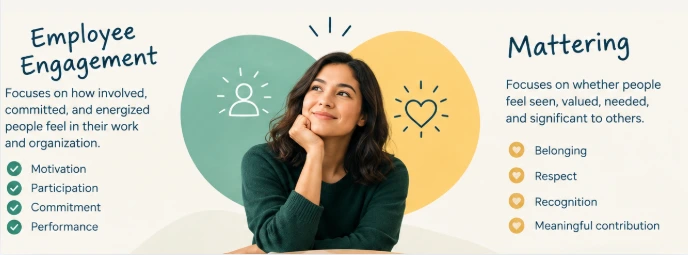
Employee engagement refers to the degree to which employees feel involved in, committed to, and energized by their work and organization.
Engaged employees may demonstrate enthusiasm for their responsibilities, take initiative, contribute ideas, and invest effort in achieving shared goals. Their engagement can reflect their relationship with their role, their manager, their colleagues, and the organization.
Organizations often assess engagement through employee surveys, feedback sessions, and indicators related to commitment, motivation, satisfaction, and participation.
Why employee engagement matters
Employee engagement provides useful insight into how employees experience their work environment. It can help leaders identify obstacles, understand employee concerns, and examine the conditions that support employees’ connection to organizational goals.
For example, engagement surveys may help organizations understand whether employees:
- Feel motivated to perform their responsibilities.
- Understand the organization’s goals.
- Have the resources they need to succeed.
- Trust their managers.
- Feel connected to their teams.
- See opportunities for professional development.
These insights can help leaders make informed improvements.
However, engagement measures do not necessarily answer every question about an employee’s experience. Someone can be enthusiastic about a project and committed to its success while still feeling that their individual contribution or humanity goes unrecognized.
That is where mattering becomes important.
What Is Mattering at Work?
Mattering at work is the experience of feeling seen, valued, and needed, with a genuine sense that one’s presence and contributions make a meaningful difference.
It goes beyond receiving praise, meeting targets, or being recognized for a successful project. Mattering concerns whether employees experience themselves as significant people within their workplace relationships and community.
In a workplace where people experience mattering, they are not valued only for what they produce. Their perspectives are considered, their contributions are acknowledged, and their well-being is treated as important.
The broader concept of the Mattering Effect explores why the human need to feel seen, valued, and needed deserves attention in everyday life and work.
The two dimensions of mattering
Mattering involves two closely related experiences.
Feeling valued: Knowing that other people recognize your worth, contributions, perspectives, and presence.
Adding value: Understanding that your actions and contributions make a meaningful difference to other people, a team, or a larger purpose.
These experiences are related, but human worth should never be reduced to performance. An employee’s significance does not disappear when they make a mistake, need support, or cannot perform at their usual level.
Being needed is not the same as mattering
An organization may depend heavily on an employee without making that person feel valued.
Consider an employee who regularly solves problems, supports colleagues, and accepts additional responsibilities. Their team relies on them, but their manager rarely asks for their perspective or notices when they are struggling.
The employee is needed. But do they feel that they matter?
Being needed can create responsibility. Mattering adds the experience of human significance, respect, and recognition.
When people continually give their time, energy, and expertise but feel little acknowledgment or support in return, they may experience the Mattering Gap: the painful distance between what they give to the world and how much they feel seen, valued, and significant.
Mattering vs. Employee Engagement: What Is the Difference?
Although mattering and employee engagement can influence one another, they answer different questions about the employee experience.
| Dimension | Employee Engagement | Mattering at Work |
| Central question | Am I involved in and committed to my work? | Do I feel seen, valued, and significant? |
| Primary focus | Connection to work and the organization | Human worth and significance |
| Common indicators | Enthusiasm, commitment, participation, and initiative | Feeling respected, heard, valued, and able to make a difference |
| Leadership concern | How can we support employees’ connection to their work? | How can we help employees experience their significance? |
| Potential blind spot | An engaged employee may still feel personally overlooked | An employee who feels valued may still be frustrated with their role |
| Useful question | Are employees invested in their work? | Do employees feel that their presence matters? |
The central distinction is that engagement describes an employee’s relationship with their work, while mattering focuses on their experience of significance within their human environment.
Neither concept replaces the other. Together, they offer a more complete perspective on the employee experience.
Can Employees Be Engaged Without Feeling That They Matter?
Yes. Employees can be highly engaged while experiencing a lack of mattering.
Imagine a project manager who consistently delivers complex projects on time. They care about their work, take pride in their responsibilities, and remain committed to the organization’s goals.
However, their manager rarely asks for their input before making decisions. Their contributions go unacknowledged, and their concerns about workload are repeatedly dismissed.
The project manager may remain engaged because they care about the work, their professional standards, or the people who depend on them. Yet their experience of mattering may gradually weaken.
They may begin to wonder:
- Does my perspective carry any weight?
- Would anyone notice if I stopped contributing beyond my formal responsibilities?
- Am I valued as a person, or only as a reliable source of results?
- Does my presence make a difference beyond the tasks I complete?
These questions highlight a potential gap between outward performance and an employee’s internal experience.
The experience of being overlooked can also take subtler forms. In some workplaces, people may appear visible because their work receives attention, yet still feel that the person behind the work is not truly seen. This tension is explored in The Visibility Illusion.
The important point is that high engagement does not automatically mean an employee feels valued, respected, or significant.
Can Employees Feel That They Matter Without Being Highly Engaged?
Yes. Mattering and engagement are distinct experiences, so one does not guarantee the other.
An employee may feel respected by their manager, appreciated by colleagues, and confident that their contribution makes a difference. At the same time, they may feel unchallenged by their role, frustrated by administrative processes, or disconnected from a particular project.
For example, a teacher may feel deeply valued by students and colleagues but feel disengaged from administrative tasks that take time away from teaching.
Their sense of mattering may remain strong even when their enthusiasm for certain responsibilities is low.
This distinction is important because leaders should not assume that every engagement problem results from a lack of appreciation. Workload, compensation, career opportunities, management practices, and job design can also influence how employees experience work.
Supporting employees means addressing these practical concerns while recognizing their need for significance and belonging.
Why Organizations Need to Understand Both
Organizations often focus on performance, participation, retention, and engagement survey results. These measures can be useful, but they offer only part of the picture.
Understanding mattering adds another perspective: whether people feel that their presence, perspectives, and contributions count.
1. Engagement shows involvement; mattering explores significance
An employee may participate actively in meetings and volunteer for projects. These behaviors can indicate engagement, but they do not establish whether the employee feels respected or heard.
Leaders need to look beyond participation and consider whether employees have meaningful opportunities to contribute and influence decisions.
2. Recognition cannot replace everyday human respect
Recognition programs, team events, and awards can be valuable. However, they cannot substitute for the everyday experience of being treated as a person whose perspective matters.
A thank-you message is more meaningful when it reflects a genuine understanding of someone’s contribution. Recognition should be specific, sincere, and connected to the person rather than merely to a result.
3. Performance can hide the human cost of work
Some employees continue delivering exceptional results even when they feel overlooked or depleted.
If leaders focus exclusively on output, they may miss the personal cost of that performance. They may also fail to notice when dependable employees repeatedly absorb additional responsibilities without receiving adequate support.
Leaders should ask not only what employees are producing, but also what they are experiencing while producing it.
4. Workplace systems influence whether people feel valued
Mattering is not solely an individual relationship issue. Organizational policies, decision-making processes, workloads, and recognition practices can also influence employees’ experiences.
Systemic unmattering describes systems that reward output while treating human worth as optional. This perspective encourages organizations to examine whether their practices consistently recognize people as human beings rather than treating them only as sources of labor.
A workplace cannot solve every mattering problem through individual praise if its broader systems repeatedly dismiss employee concerns or make meaningful participation difficult.
How Leaders Can Build Both Employee Engagement and Mattering
Building a workplace where people feel engaged and that they matter requires more than a single initiative. It calls for attention to relationships, decision-making, recognition, and the conditions in which people work.
The M.A.T.T.E.R. framework offers a practical lens through six dimensions: Meaning, Autonomy, Trust, Time, Energy, and Reciprocity.
M — Meaning: Connect work to a meaningful contribution
Employees need to understand how their responsibilities contribute to something beyond a list of tasks.
Leaders can explain how individual work supports colleagues, customers, communities, or organizational goals. They can also invite employees to describe which parts of their work feel most meaningful.
Practical action: During one-to-one meetings, ask, “Which part of your work feels most meaningful to you, and where would you like to make a greater difference?”
A — Autonomy: Give people a meaningful voice
Autonomy involves having appropriate control over one’s work and the opportunity to exercise judgment.
Employees can experience greater significance when their ideas are considered and their expertise influences relevant decisions. Asking for input without genuinely considering it can undermine trust.
Practical action: Involve employees in decisions that affect their responsibilities, explain the reasoning behind final decisions, and clarify how their input was considered.
T — Trust: Create conditions for honest conversations
Trust shapes whether employees feel comfortable asking questions, admitting mistakes, raising concerns, and sharing ideas.
A leader who responds to disagreement with curiosity rather than defensiveness can help employees experience their perspectives as welcome.
Practical action: Ask employees what is making their work harder, listen without immediately correcting them, and follow up with clear actions or explanations.
T — Time: Make room for the person behind the role
Employees are more than the hours they work and the tasks they complete. Meaningful conversations require time to understand what people are experiencing, what they need, and where they may be struggling.
Practical action: Use regular one-to-one conversations to discuss workload, professional growth, obstacles, and the employee’s experience of the team—not just project status.
E — Energy: Recognize the human resources work requires
People have limits. Sustained contribution depends partly on whether workplace demands are compatible with employees’ capacity and available resources.
A workplace that celebrates constant availability may communicate that people are valuable only when they continue to give more.
Practical action: Review workloads, clarify priorities, remove unnecessary obstacles, and address patterns in which the same employees repeatedly absorb additional responsibilities.
R — Reciprocity: Make contribution feel mutual
Reciprocity means that workplace relationships involve a meaningful exchange of care, respect, support, and contribution.
It does not mean that every act of help must be repaid immediately. It means employees should not continually give their time, effort, and expertise without experiencing respect, support, or acknowledgment in return.
Practical action: Recognize contributions specifically, offer support when employees need it, and examine whether responsibility and recognition are distributed fairly.
Leaders looking to put these ideas into practice can explore how to build a culture of mattering. The goal is to make mattering part of everyday workplace behavior rather than treating it as a one-time initiative.
How to Measure Mattering Alongside Employee Engagement
Employee engagement can be assessed through established surveys and organizational indicators. Mattering requires additional attention to how employees experience their relationships, contributions, and significance.
There is no single universal question or score that fully captures mattering in every workplace. Organizations can begin by combining confidential employee feedback, thoughtful conversations, and observations of workplace practices.
Consider exploring these questions.
Feeling seen
- Do people recognize my contributions and understand the work I do?
- Does my manager notice when my responsibilities or circumstances change?
Feeling valued
- Am I treated with respect even when I disagree or make a mistake?
- Do people value my perspective as well as my output?
Feeling needed and significant
- Do I understand how my contribution makes a difference?
- Can my work influence decisions, outcomes, or the experiences of others?
Experiencing reciprocity
- Can I ask for help without feeling that I have lost my value?
- Does the organization respond when people repeatedly carry an unsustainable workload?
Organizations can use these questions as prompts for developing employee listening practices. They should not automatically treat them as a validated psychological scale.
The purpose is not to replace engagement surveys with another score. It is to understand the human experience behind the numbers.
What Happens When Engagement Is Prioritized but Mattering Is Overlooked?
When organizations focus heavily on performance and engagement without considering employees’ sense of significance, an important part of the workplace experience can remain invisible.
An employee may continue meeting expectations while gradually withdrawing ideas, limiting their willingness to help beyond their formal duties, or questioning whether their work is worth the effort they invest.
The process may be subtle. There may be no immediate resignation, conflict, or visible decline in performance.
Over time, repeatedly feeling overlooked may affect how people relate to their work and workplace relationships. This is not inevitable, and it should not be treated as a universal outcome. It is a reason to look beyond performance indicators when evaluating the employee experience.
Leaders should ask:
- Do employees receive attention only when something goes wrong?
- Are people praised for taking on more but overlooked when they need support?
- Can employees disagree without being dismissed?
- Are contributions acknowledged fairly across the team?
- Do workplace systems support human needs as well as organizational goals?
These questions help leaders examine whether their organizations recognize the person behind the performance.
A Practical Example: Engagement vs. Mattering in Everyday Leadership
Consider two managers leading teams with similar responsibilities.
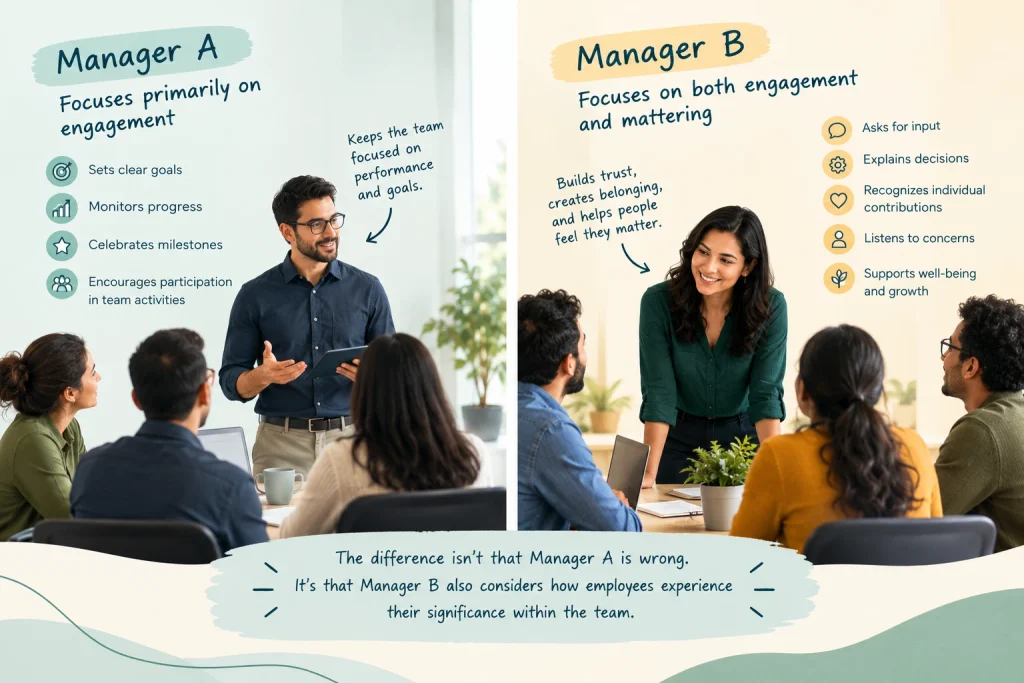
Manager A focuses primarily on engagement.
They set clear goals, monitor progress, celebrate milestones, and encourage employees to participate in team activities. These practices can help employees understand their responsibilities and remain connected to their work.
However, conversations rarely extend beyond performance, and employees have limited influence over decisions that affect them.
Manager B focuses on both engagement and mattering.
They establish clear goals and celebrate progress, but they also ask employees for input, explain how decisions are made, recognize individual contributions, and respond when people raise concerns. They make time to understand employees’ experiences and ensure that support is available when demands become excessive.
The difference is not that Manager A’s approach is inherently wrong. Goals, feedback, and recognition remain important.
The difference is that Manager B also considers how employees experience their significance within the team.
This approach does not guarantee higher engagement or eliminate workplace challenges. It creates more opportunities for employees to experience their work as a place where both their contributions and their humanity are taken seriously.
For a closer look at common leadership blind spots, read Mattering at Work: What Managers Get Wrong.
From Employees as Resources to People Who Matter
A workplace can depend on people without helping them feel significant.
Organizations need employees’ skills, time, judgment, and effort. But when people are valued only for what they provide, their worth can become tied to their usefulness.
The distinction between a resource and a source is important here. A resource is something an organization uses to accomplish a task. A person is also a source of ideas, judgment, relationships, creativity, and meaningful contribution.
People are not interchangeable units of output. Their experiences, perspectives, and relationships cannot be fully understood through performance indicators alone.
Mattering asks organizations to examine the gap between what people contribute and how much they experience being seen, valued, and needed.
Closing that gap does not mean abandoning organizational goals. It means pursuing those goals without treating human worth as optional.
A workplace can care about results and care about people. Understanding both gives leaders a more complete picture of what their employees experience.
Frequently Asked Questions
1. What is the difference between mattering and employee engagement?
Employee engagement describes how involved, committed, and energized employees feel in relation to their work and organization. Mattering refers to the experience of feeling seen, valued, needed, and significant to others. Engagement focuses on connection to work; mattering focuses on human significance. The two can influence one another, but they are not interchangeable.
2. Can an employee be engaged but not feel valued?
Yes. An employee may be committed to their work, motivated by professional standards, or passionate about a project while feeling overlooked by their manager or organization. Engagement does not automatically mean that an employee feels respected, heard, or valued as a person.
3. Is mattering the same as employee recognition?
No. Recognition can contribute to mattering, but the concepts are different. Recognition often involves acknowledging an achievement or contribution. Mattering is a broader experience of being seen, valued, and significant. An employee may receive public praise yet still feel ignored when decisions are made or concerns are raised.
4. Why is mattering important in the workplace?
Mattering helps organizations consider whether employees experience their presence and contributions as meaningful. It encourages leaders to look beyond output and participation to examine respect, voice, recognition, relationships, and reciprocity.
5. How can managers help employees feel that they matter?
Managers can listen carefully, recognize contributions specifically, involve employees in relevant decisions, respond constructively to concerns, provide appropriate autonomy, and address unsustainable workloads. Consistent everyday behavior is more meaningful than relying on occasional recognition events alone.
6. How is mattering measured?
Mattering can be explored through confidential employee feedback, one-to-one conversations, and questions about whether employees feel seen, valued, heard, and able to make a difference. Organizations should be careful not to treat informal questions as a validated psychological scale. Mattering assessments should complement established engagement measures.
7. Does improving mattering automatically improve employee engagement?
Not necessarily. Mattering and engagement are related but distinct. Employees may feel valued while experiencing excessive workloads, limited career opportunities, or frustration with their responsibilities. Supporting both requires attention to employees’ human significance and the practical conditions of their work.
8. What is the M.A.T.T.E.R. framework?
The M.A.T.T.E.R. framework explores six dimensions of the human experience: Meaning, Autonomy, Trust, Time, Energy, and Reciprocity. It offers a practical way to examine whether workplace conditions support meaningful contribution, agency, respect, and mutual support.
9. What is the Mattering Gap?
The Mattering Gap is the painful distance between what a person gives to the world and how much they feel seen, valued, and significant in return. At work, it may emerge when employees consistently contribute effort and expertise but experience little acknowledgment, influence, or support.
10. Can a workplace have high engagement and still have a mattering problem?
Yes. High engagement results do not necessarily establish that every employee feels valued or significant. Some employees may remain highly committed while experiencing a lack of voice, recognition, or reciprocity. Looking at both engagement and mattering can help leaders develop a more complete understanding of employees’ experiences.
Conclusion: Employees Need More Than a Reason to Work
Employee engagement matters. Organizations need people who can connect with their work, contribute their abilities, and participate in shared goals.
But engagement does not tell the whole story.
People also need to experience their significance. They need to know that their voices count, their contributions make a difference, and their worth extends beyond what they produce.
Understanding mattering vs. employee engagement helps leaders recognize the difference between having committed employees and creating a workplace where people feel that they genuinely matter.
The next step is not simply to ask employees to become more engaged. It is to examine the conditions in which they work, the relationships they experience, and the signals the organization sends about their value.
Through Meaning, Autonomy, Trust, Time, Energy, and Reciprocity, leaders can begin to build workplaces that take both contribution and human significance seriously.
Because the goal is not merely to help people perform well.
It is to create environments where people can contribute meaningfully without losing their sense of worth.
You were never meant to disappear from your own life.