




Introduction: Employees Want to Know They Matter
A leader can give an employee a good salary, clear responsibilities, and opportunities to grow, and that employee can still feel invisible.
Why?
Because people do not only want to know that their work is getting done. They want to know that they are seen, their contributions matter, their voice carries weight, and their presence makes a difference.
This is at the heart of what it means to feel valued at work.
The question for leaders is not simply, “Are my employees productive?”
It is also:
“Do the people who work with me feel that they matter?”
When employees feel valued, recognition becomes more meaningful, conversations become more honest, and people are more likely to bring their ideas, concerns, strengths, and full attention to the work.
Gallup’s workplace research similarly emphasizes several experiences connected to feeling valued: receiving recognition, having opinions count, having someone who cares about you as a person, having opportunities to use your strengths, and having opportunities to develop.
Feeling valued is therefore not a perk or occasional compliment. It is part of the everyday experience of work.
What Does It Mean to Feel Valued at Work?
Feeling valued at work means experiencing a consistent sense that your contribution, perspective, effort, and presence are recognized as meaningful.
It is different from simply receiving praise.
An employee may receive a “great job!” message and still feel overlooked if:
- Their ideas are routinely ignored.
- Their effort is only noticed when something goes wrong.
- Decisions affecting them are made without their input.
- Their manager rarely asks how they are doing.
- Their growth has stopped.
- Their work feels disconnected from anything meaningful.
- Recognition appears selective or performative.
This distinction matters.
Recognition says, “I noticed what you did.”
Mattering says, “I see you, I understand your contribution, and it makes a difference.”
That deeper experience is what leaders should work toward.
Why Feeling Seen and Heard Matters in Leadership
Leadership is often described in terms of strategy, performance, decision-making, and results. But leadership also shapes how people experience themselves at work.
When employees believe their opinions count, their work is meaningful, and someone cares about them as people, the workplace communicates something important:
You are not invisible here.
Gallup’s Q12 research includes whether employees feel that their opinions count, whether someone at work cares about them as a person, whether they receive recognition, and whether they have opportunities to use their strengths and develop.
Research from Self-Determination Theory also identifies autonomy, competence, and relatedness as fundamental psychological needs in organizational settings. Supportive workplace environments can help employees experience greater ownership, effectiveness, and connection.
For leaders, this creates a practical lesson:
People are more than resources to be managed. They are people whose experience of work influences how they participate in it.
8 Ways Leaders Can Make Employees Feel Valued
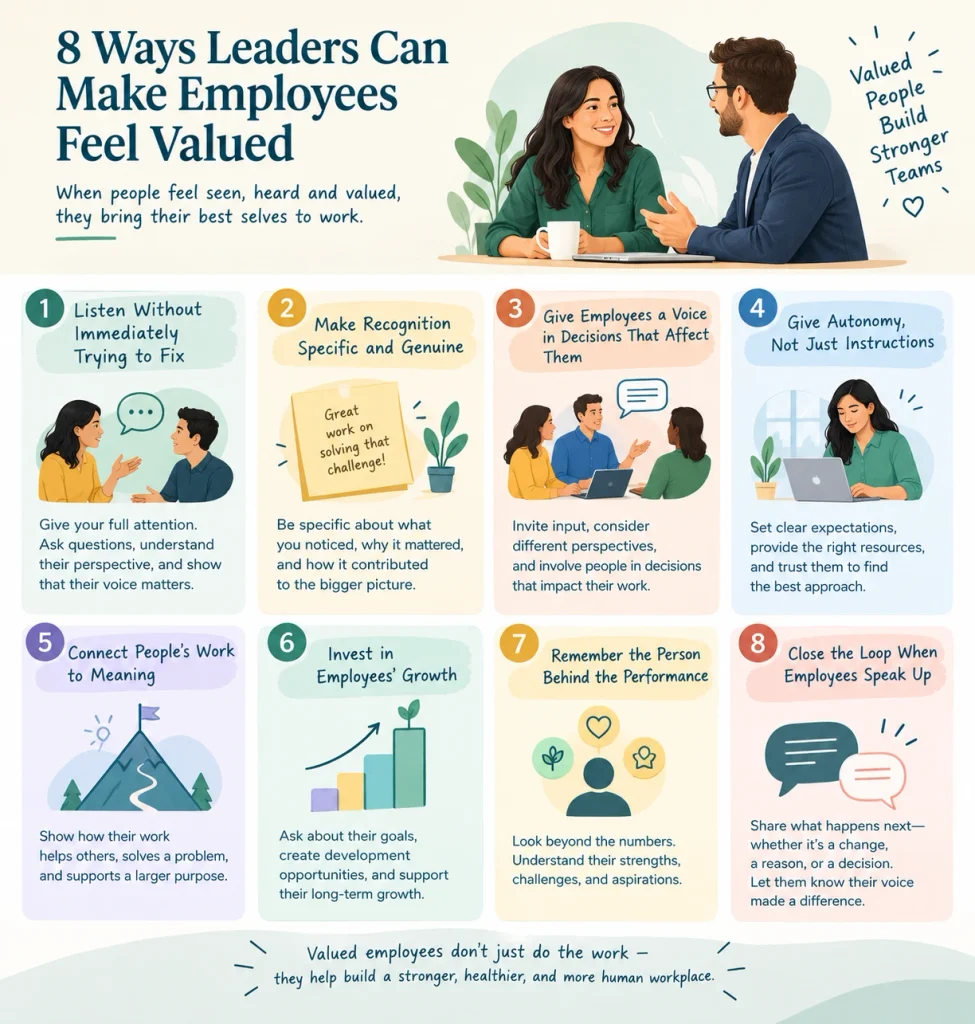
1. Listen Without Immediately Trying to Fix
One of the simplest ways to make employees feel heard is to actually listen.
When an employee raises a concern, resist the instinct to immediately explain, defend, or solve.
Instead, ask:
“Tell me more about that.”
“What are you seeing that I might be missing?”
“What would make this better?”
“What do you think we should do?”
Listening does not mean agreeing with everything an employee says.
It means demonstrating that their perspective deserves consideration.
A leader can disagree with an employee and still make that employee feel heard.
2. Make Recognition Specific and Genuine
Generic praise has limited meaning.
Compare:
“Great work.”
with:
“The way you identified that problem before it affected the client saved the team significant time.”
The second statement tells the employee exactly what the leader noticed and why it mattered.
Research from Gallup and Workhuman suggests that recognition is more meaningful when it is authentic, specific, purposeful, and connected to the person’s contribution. Their research also found strong relationships between authentic recognition and employees’ perceptions that they are valued members of their teams.
Good recognition answers three questions:
- What did you notice?
- Why did it matter?
- What did it contribute?
3. Give Employees a Voice in Decisions That Affect Them
Employees do not need to make every decision.
But when a decision directly affects someone’s work, giving them an opportunity to contribute can change how they experience that decision.
Instead of:
“Here is what we’re doing.”
Try:
“Here is the direction we’re considering. What do you think we should account for before we move forward?”
This creates a sense of participation rather than simply compliance.
It also helps leaders access information they may not have themselves.
The people closest to a process often see problems, opportunities, and unintended consequences before senior leadership does.
4. Give Autonomy, Not Just Instructions
Micromanagement can communicate an unintended message:
“I don’t trust you to handle this.”
Autonomy communicates something different:
“I trust you to take ownership of this.”
That does not mean abandoning employees or providing no structure.
Healthy autonomy combines:
- Clear expectations
- Appropriate resources
- Defined outcomes
- Freedom in how the work gets done
- Support when obstacles arise
Self-Determination Theory research connects autonomy-supportive environments with employees’ psychological needs for autonomy, competence, and relatedness.
Leaders can create autonomy by asking:
“What approach do you think will work best?”
rather than always providing the answer themselves.
5. Connect People’s Work to Meaning
People can become disconnected when their work feels like an endless sequence of tasks.
Leaders can help by making the connection visible.
Instead of simply assigning work, explain:
- Who benefits from this work?
- What problem does it solve?
- Why does it matter?
- How does this contribute to the larger mission?
This is where Meaning, the first element of the M.A.T.T.E.R. framework, becomes important.
When people can see the meaning behind their contribution, work becomes more than output.
It becomes participation in something larger than the task itself. This connection between success and mattering helps leaders consider not just what employees achieve, but how they experience their contribution.
6. Invest in Employees’ Growth
Employees want to know that their future matters, not only their current performance.
Ask employees:
“What do you want to learn next?”
“What kind of work would you like more exposure to?”
“What responsibility would you like to take on?”
“What skill would make you more confident?”
“Where do you see yourself growing?”
Then look for ways to create opportunities around those answers.
Growth does not always require a promotion.
It can involve mentoring, new responsibilities, training, challenging assignments, cross-functional work, or greater ownership.
Gallup’s workplace framework includes opportunities for development and progress conversations among the conditions associated with strong employee experiences.
7. Remember the Person Behind the Performance
One of the easiest leadership mistakes is to reduce an employee to their output.
Did they hit the target?
Did they finish the project?
Did they meet the deadline?
Those questions matter.
But so does:
“How is this person doing?”
A manager who knows an employee’s strengths, interests, challenges, and aspirations can lead that person more effectively than someone who only knows their performance metrics.
This does not mean leaders need to become therapists or know every detail of an employee’s personal life.
It means treating people as people.
Gallup’s research specifically includes whether employees feel that someone at work cares about them as a person.
8. Close the Loop When Employees Speak Up
Nothing makes people feel unheard faster than being asked for feedback that disappears into a black hole.
If employees raise an issue, leaders should communicate what happened next.
Sometimes the answer will be:
“Yes, we’re going to change this.”
Sometimes it will be:
“We considered the suggestion, but we’re not going to implement it because of these constraints.”
Both can be respectful.
Silence is different.
Closing the loop tells employees:
“Your voice reached someone, and it was taken seriously.”
That is a powerful leadership behavior.
The M.A.T.T.E.R. Framework for Leaders
The Mattering Effect’s M.A.T.T.E.R. framework provides a useful way to think about how leaders create environments where people can experience significance and worth.
M — Meaning
Help employees understand why their work matters.
A — Autonomy
Give people appropriate ownership and choice in how they contribute.
T — Trust
Demonstrate confidence in people’s judgment while creating accountability.
T — Time
Make time for conversations, listening, recognition, and development.
E — Energy
Pay attention to what gives people energy and what consistently drains it.
R — Reciprocity
Create relationships where contribution, recognition, support, and care move in both directions.
Together, these elements help leaders move beyond managing performance toward understanding the human experience behind performance.
Recognition Alone Is Not Enough
Recognition is important, but leaders should be careful not to confuse recognition with mattering.
An employee might receive an award once a year and still feel invisible every day.
Research from Gallup and Workhuman has found that authentic recognition is associated with employees feeling valued and connected to their organization. At the same time, their research emphasizes that recognition needs to be meaningful, genuine, specific, and appropriately delivered.
The deeper question is:
Does the employee experience value consistently, or only occasionally?
Mattering is built through repeated experiences.
A leader who listens today but ignores an employee for the next six months is sending mixed signals.
A leader who consistently listens, recognizes contributions, creates opportunities, and follows through creates something stronger:
a pattern of mattering.
For a deeper look at common leadership misunderstandings, explore what managers get wrong about mattering at work.
When Employees Stop Feeling Valued
The opposite of mattering rarely happens all at once.
It can happen gradually.
A person offers an idea. Nothing happens.
They work late. Nobody notices.
They raise a concern. Nothing changes.
They ask for growth. The conversation is postponed.
They contribute repeatedly. Someone else receives the credit.
Over time, these experiences can create what The Mattering Effect describes as The Slow Fade, the gradual experience of becoming less visible, less connected, and less certain that your presence makes a difference.
This is why leaders should pay attention to small signals.
An employee who has become unusually quiet may not have suddenly stopped caring.
They may have stopped believing that speaking up matters.
These experiences can contribute to feeling invisible at work, particularly when employees repeatedly find that their ideas, effort, or concerns receive little meaningful response.
The Mattering Tax on Leadership
When people do not feel valued, organizations can pay what The Mattering Effect calls The Mattering Tax.
It can show up as:
- Reduced participation
- Withheld ideas
- Less honest communication
- Lower connection
- Disengagement
- Increased friction
- People doing only what is required
- Employees mentally or emotionally withdrawing
The problem is not simply that people become less productive.
The deeper problem is that people may stop bringing their full selves to the work.
Leaders can reduce this tax by creating everyday experiences that communicate:
I see you.
I hear you.
Your contribution matters.
You matter here.
The mattering gap helps describe the disconnect between what people contribute and the extent to which their environment reflects their significance and worth.
From Mattering Tax to Mattering Dividend
The alternative is the Mattering Dividend: the positive effect that can emerge when people consistently experience themselves as seen, valued, and needed.
It can begin with surprisingly ordinary leadership behaviors:
A thoughtful question.
A specific thank-you.
An invitation to contribute.
A follow-up after someone raises a concern.
A meaningful opportunity.
A manager remembering what an employee said last month.
None of these actions requires a large budget.
But together, they shape the culture people experience every day.
Leaders who want to create these experiences across their teams can also explore how to build a culture of mattering.
A Simple Leadership Check-In
Leaders can use these five questions during one-on-one conversations:
- What is giving you energy right now?
- What is draining your energy?
- Where do you feel your contribution is making a difference?
- Where do you feel unheard or overlooked?
- What is one thing I could do differently to better support you?
The goal is not to ask these questions once and consider the job finished.
The goal is to create a pattern of listening and responding.
Because mattering is not created by one conversation.
It is created by what happens repeatedly.
How Leaders Can Tell Whether Employees Feel Valued
Leaders should not rely only on assumptions.
Instead, look for evidence in employee experience.
Useful questions include:
- Do employees feel comfortable sharing ideas?
- Do people believe their opinions count?
- Is recognition specific and equitable?
- Do employees understand how their work contributes to something meaningful?
- Do managers make time for meaningful conversations?
- Are employees given appropriate autonomy?
- Do people have opportunities to grow?
- When employees provide feedback, does leadership close the loop?
Gallup’s research provides several comparable workplace indicators, including recognition, care from supervisors, opportunities to use strengths, employee voice, purpose, and development.
These questions can help leaders move from “I think my employees feel valued” to “Here is what their experience is telling us.”
How Do Leaders Make Employees Feel Valued, Seen, and Heard?
Leaders can make employees feel valued, seen, and heard by consistently recognizing meaningful contributions, listening to employee perspectives, giving people appropriate autonomy, supporting growth, connecting work to purpose, showing genuine care, and following through on feedback.
The key is consistency.
Employees are more likely to experience mattering when these behaviors become part of everyday leadership rather than occasional initiatives.
Frequently Asked Questions
What is the best way to make employees feel valued?
Start by listening to employees, recognizing their specific contributions, giving them appropriate autonomy, supporting their development, and showing how their work contributes to a meaningful purpose. Consistency is more important than occasional grand gestures.
How can leaders make employees feel heard?
Leaders can make employees feel heard by asking for their perspectives, listening without immediately dismissing or correcting them, involving them in relevant decisions, and closing the loop after they provide feedback.
Being heard does not necessarily mean getting your preferred outcome. It means knowing your perspective was genuinely considered.
Why is employee recognition important?
Recognition communicates that an employee’s contribution has been noticed. Research from Gallup and Workhuman indicates that authentic recognition is associated with employees feeling valued, respected, and connected to their workplace.
How can managers show employees they care?
Managers can show care by making time for meaningful conversations, understanding employees as individuals, asking about their development, recognizing their efforts, providing support during challenges, and respecting appropriate boundaries.
Does making employees feel valued improve engagement?
Research connects several experiences associated with feeling valued, including recognition, meaningful work, development, employee voice, and supportive management, with important aspects of employee engagement and workplace experience.
However, feeling valued should not be treated only as a technique for increasing productivity. People deserve to experience dignity, respect, and significance at work regardless of the immediate business outcome.
What is the difference between employee recognition and mattering?
Employee recognition focuses on acknowledging a person’s contribution or achievement.
Mattering is broader.
It includes the experience of being seen, valued, needed, and significant, not only because of what you produce, but because of who you are and the difference your presence makes.
How does autonomy help employees feel valued?
Autonomy gives employees appropriate ownership over their work. Instead of communicating that every decision must come from above, leaders demonstrate trust in employees’ ability to make decisions within clear boundaries. Self-Determination Theory identifies autonomy as one of three basic psychological needs alongside competence and relatedness.
What happens when employees consistently feel ignored?
When employees repeatedly experience being overlooked or unheard, they may become less likely to contribute ideas, raise concerns, seek connection, or invest discretionary effort. The experience can contribute to a broader sense of disconnection and unmattering.
The specific effects vary between individuals and workplaces, so leaders should look at employee feedback and behavior rather than assume one universal response.
Final Thought: Leadership Is Also About Making People Matter
Leadership is not only about getting people to accomplish more.
It is also about creating an environment where people can experience themselves as significant.
The employee who speaks up in a meeting.
The person quietly solving problems nobody sees.
The team member helping a colleague succeed.
The employee learning a new skill.
The person who has an idea but is not sure anyone wants to hear it.
Each of them is asking, in one way or another:
Does what I do matter here?
Great leadership does not answer that question with slogans.
It answers through everyday behavior.
By listening.
By noticing.
By trusting.
By making time.
By creating meaning.
By following through.
And by remembering that behind every role, title, metric, and deliverable is a human being who wants to know:
“Do I matter?”
Because people were never meant to disappear from their own lives, or from the work they give so much of themselves to.